


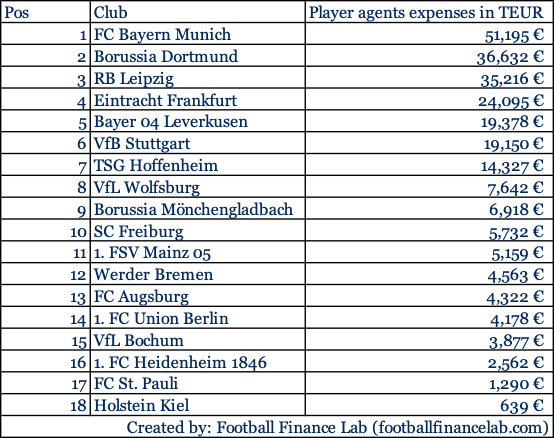
What player agents do and how much they are involved in transfers often remains a well-kept secret. How much they earn from transfers is even less known to the public, and it is difficult to obtain valid figures. Every year, the DFL publishes an annual report for the Bundesliga, listing the clubs’ expenditure on player agents. In this article, we want to analyse the respective expenditure of the clubs. All data is taken from the aforementioned DFL financial report and is based on the balance sheets as of 30 June 2024. Only four teams, 1. FC Heidenheim, Bayer Leverkusen, Borussia Mönchengladbach and VfB Stuttgart, reported their figures as of 31 December 2024. The transfer fees come from Transfermarkt . The following table shows all expenditure by Bundesliga clubs on player agents in the 2024/25 season.
Analysis: How much each Bundesliga club spent on player agents
Unsurprisingly, FC Bayern Munich is way out in front with approximately €51.2 million spent on player agents (as with many other statistics, you can find more articles on the Bundesliga here). Borussia Dortmund and RB Leipzig follow with €36.6 million and €35.2 million respectively. There are huge differences in many financial indicators within the league, which is also the case when it comes to spending on player agents. TSG Hoffenheim is in 7th place with €14.3 million and VfL Wolfsburg follows with about half that amount (€7.6 million), which exemplifies these large differences. The midfield of the league is close together in terms of player agent spending. Places 10-15 are in a corridor of €5.7 to €3.8 million. 1. FC Heidenheim, FC St. Pauli and Holstein Kiel occupy the bottom three places with large differences in percentage terms. 1. FC Heidenheim spent €2.5 million, approximately twice as much as FC St. Pauli, which spent €1.2 million. FC St. Pauli, in turn, spent about twice as much as Holstein Kiel, which came in last with €639,000. This means that 1. FC Heidenheim spent four times as much as Holstein Kiel. Kiel is also the only team that spent less than €1 million on player agents. One reason for this is that Kiel was still in the second division during the season in which the data was collected and the club generally does not operate like a Bundesliga club in financial terms.
In general, it can be said that the table ranking for player agent expenses is similar to the table for personnel expenses. Few places have changed, but the core groups remain the same. You can find the full article on the personnel expenses of Bundesliga teams here. On average, a Bundesliga club spent €13.7 million on player agents. However, this average is driven up by the particularly high expenditure of the top three teams. The median is €6.3 million, which is less than half the average. This shows the stark inequality between a few teams with high expenditure and many other teams that recorded significantly lower expenditure. Only the top seven teams are above the average.
Agent fees vs. transfer spending: Percentage comparison across the Bundesliga
To put the expenditure on player agents into context, we compare it with the corresponding transfer expenditure. The following table shows the expenditure on player agents, transfer expenditure and the percentage share of transfer expenditure.
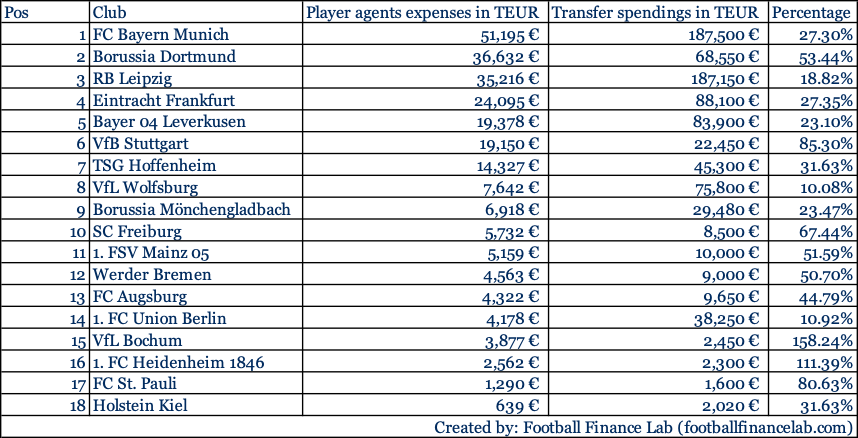
In percentage terms, VfL Wolfsburg and Union Berlin spent the least on player agents. Both teams spent around 10% of their transfer budgets. In terms of total figures, however, the two teams are still far apart. In both cases, VfL Wolfsburg spent around twice as much as the Berliners. VfL Bochum is closest to Union Berlin in terms of total figures, spending €3.8 million. However, while Union Berlin spent the least on player agents in percentage terms, VfL Bochum spent the most at 158%. At first glance, this is particularly surprising because Bochum only spent €2.45 million and did not record any transfer income. One explanation for this could be that VfL Bochum recorded a particularly high number of free transfers and therefore had to pay a lot of signing bonuses and agent fees. Alongside VfL Bochum, 1. FC Heidenheim is the only other club that paid more for player agents than for transfer fees, ranking second to last with 111%. This high percentage cannot be explained, as Heidenheim did not record a particularly high number of free transfers, significant transfer income or high transfer expenditure of €2.3 million. This could be due to several contract extensions. It is also interesting to note that Holstein Kiel, FC St. Pauli, 1. FC Heidenheim and VfL Bochum are in the bottom four places in terms of expenditure on player agents and transfer fees. Nevertheless, the percentage values differ greatly. While Heidenheim and Bochum have the highest percentages, St. Pauli has significantly lower values at around 80% and Holstein Kiel in particular at 31%.
The comparison between Borussia Dortmund and RB Leipzig is also interesting. Both clubs spent roughly the same amount on consultants, €36.6 million and €35.3 million respectively. However, the percentages differ greatly, as Leipzig paid almost three times as much in transfer fees. BVB spent 53% and Leipzig 18% of their transfer fees on consultants. A comparison can also be made between RB Leipzig and Bayern Munich. Both spent around €187 million on transfers. Bayern paid around €51 million, almost €15 million more than Leipzig for player agents. A similar comparison can also be made between Borussia Dortmund, Eintracht Frankfurt, VfL Wolfsburg and Bayer Leverkusen. These clubs are behind RB Leipzig and Bayern Munich in terms of transfer spending (€68-88 million). However, there is a wide gap between the clubs in terms of agent fees. Borussia Dortmund spent by far the most, at €36.6 million. They are followed by Eintracht Frankfurt with approximately €24 million and Bayer Leverkusen with €19.3 million. VfL Wolfsburg spent only €7.6 million on agents. This cannot be explained by transfer income, as Leverkusen, Dortmund and Wolfsburg are roughly on the same level (all around €70-75 million), while Eintracht Frankfurt recorded income of €149.5 million.
On average, clubs spent an additional 50% of their transfer expenditure on player agents. The average is distributed very unevenly among the clubs. The upper half spent only 33% of their transfer sums in percentage terms. The lower half spent 66%, which divides the league exactly into 1/3 and 2/3. Sorting the clubs by transfer expenditure reveals an additional interesting picture. Here, the top nine clubs spent an average of 25% of their transfer expenditure on player agents. For the bottom half, the figure is 75%. This suggests that the lower the clubs’ transfer expenditure, the higher the percentage of agent expenditure. This is mainly because certain expenses for player agents remain even for inexpensive or transfer-free transfers, causing them to increase as a percentage. Overall, the median is 38.21%, which reflects the average between FC Augsburg and Holstein Kiel. This shows more clearly the percentage values in the Bundesliga. In conclusion, it can be said that clubs that are economically strong and spend a lot on the transfer market do not have high percentage expenditure on player agents, but are clearly at the top in terms of total figures. This also makes sense because 10% of a player’s transfer fee or signing bonus is paid to the player’s agent as a fee. This cannot be confirmed in the figures (in terms of pure transfer expenditure), but this may also be due to additional agent payments based on transfer income from player sales or contract extensions.