


The German Football League (DFL) recently published the financial figures for the 36 first and second division clubs. This article shows all relevant financial figures from the previous year’s balance sheets. Among other things, it shows key figures such as equity, liabilities, turnover and profit. It also shows how high personnel expenses were in the last financial year. The financial years of most Bundesliga clubs run from 1 July to 30 June of each year. This is because the financial year is aligned with the cycle of a season and the associated player contracts. Only four teams, 1. FC Heidenheim, Bayer Leverkusen, Borussia Mönchengladbach and VfB Stuttgart, report on a calendar year basis. Based on the published report, Football Finance Lab analyses how much Bundesliga clubs spent on personnel last year and how they performed on the pitch.
Before we look at the figures together, let’s first explain what personnel expenses in the Bundesliga comprise. Personnel expenses refer to all costs incurred by a club for its employees. The most important components here are player salaries, salaries for coaches and support staff, social security contributions and insurance, as well as salaries for operational staff (e.g. office staff, marketing, ticketing, etc.). These salaries also include some of the costs incurred by employees in youth departments. Personnel expenses are therefore the largest block in the costs of Bundesliga clubs, because coaches and players are expected to lead the clubs to sporting success on the pitch. The ratio of personnel expenses (match operations + trade/administration) to total revenue in the 2023/24 season was 42.3% across the entire Bundesliga.
The following table shows last year’s Bundesliga table, including personnel expenses in TEUR.
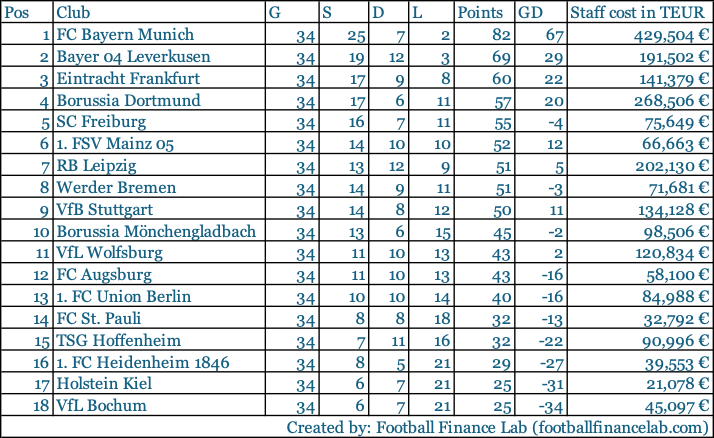
FC Bayern Munich ranks first with TEUR 429,504. This puts the German champions firmly at the top of the table. Borussia Dortmund follows in second place with approximately EUR 160 million less in personnel expenses. By way of comparison, Eintracht Frankfurt, in third place, had the fifth-highest personnel expenses at TEUR 141,379. This is roughly equivalent to FC Bayern having the personnel of BVB at its disposal, plus that of Eintracht. This demonstrates not only the club’s sporting dominance over the years (12 German championships in the last 13 years) but also its financial superiority. Bayer Leverkusen, the team that broke Bayern’s streak of 11 consecutive championships in the 2022/23 season, ranks fourth with T€191,502.
The distribution of personnel expenses is also particularly interesting. On average, a Bundesliga team spent €120 million on personnel last season. However, only seven teams reached or exceeded this mark. The median is T€87,992 (as the median can fall to 9th and 10th place, the middle of both rankings was chosen for this purpose). This shows the gap within the Bundesliga and, in particular, a multi-class society. As described in the previous paragraph, FC Bayern Munich is alone at the top. Borussia Dortmund can then be placed in its own second category. RB Leipzig and Bayer Leverkusen, in third and fourth place, also form their own cluster. In our analysis, the first four teams are therefore assigned to three separate clusters. The remaining 14 first division teams are also divided into three groups. Places 4-7 are assigned to their own cluster, and places 8-14, as the ‘middle class’ of the league, are also assigned to their own group. Places 15-18 are also grouped together, although Holstein Kiel could also be shown in its own group here, as fellow relegated team VfL Bochum is in the same cluster but spent more than twice as much on personnel (T€45,097) as Holstein Kiel (T€21,078).
Every point is worth a million – does money score goals? Money earns points!
An interesting comparison that can be made is the ratio of personnel expenses to points that the clubs had in their accounts at the end of the season. This is a good way of illustrating how much money a club has to spend per point.
The following table has been supplemented with personnel expenses per point.
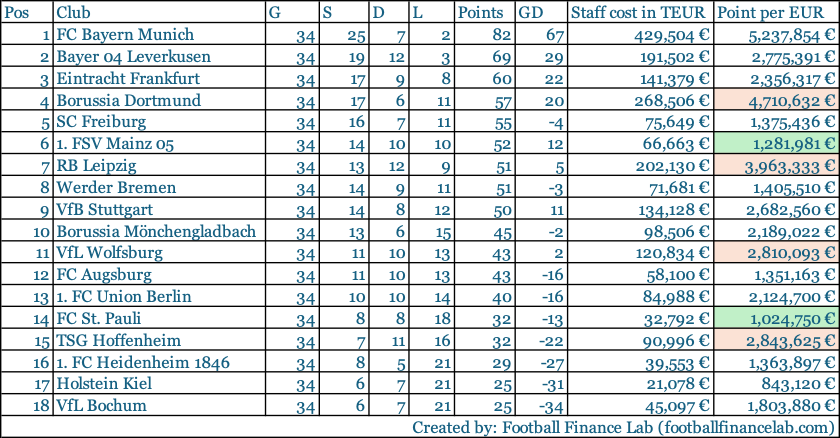
What is particularly striking is that, with the exception of Holstein Kiel, all first division clubs spent at least one million euros per point. It is also noticeable that Bayern Munich remains at the top of this category, but Borussia Dortmund is significantly closer to Bayern. This is due to BVB’s poor performance. Dortmund’s low points tally means that the cost per point is significantly higher
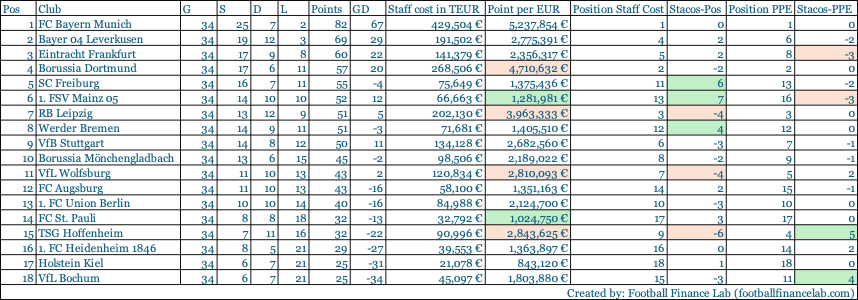
The so-called plastic clubs also have particularly high values. RB Leipzig, TSG Hoffenheim and VfL Wolfsburg follow the two leaders in third to fifth place. However, the three clubs differ greatly in terms of total expenditure. RB Leipzig spent approximately €3.9 million, while TSG and VfL spent around €2.8 million. As already explained in the case of Borussia Dortmund, poor sporting performance correlates with high club expenditure. TSG Hoffenheim, which finished only 15th at the end of the season, was particularly disappointing. If we now look at the last column, which compares the position according to personnel expenses and the final position in the table, the poor performance of these clubs becomes particularly clear. RB Leipzig and VfL Wolfsburg are four places lower than they should be according to their personnel expenses. Hoffenheim is even six places lower. This shows how little these three clubs are getting out of their financial resources.
After looking at last season’s low performers, we now turn to the clubs that got the most out of their limited resources. Holstein Kiel paid the least per point at €843,120, but the Storks also earned the fewest points and finished last in all categories of the table. FC St. Pauli, on the other hand, managed to stay in the league and had the second-lowest expenditure per point. This shows how well St. Pauli performed last season. The Kiezkickers had the second-lowest personnel expenses and still managed to finish 14th in the final table. If we take a look at the personnel expenses of the second division clubs, their achievement in staying up becomes even clearer. St. Pauli had personnel expenses of €32,792,000. This would have put St. Pauli in fourth place in the second division. The two promoted teams and first division clubs for the coming year, 1. FC Köln and Hamburger SV, finished in first and third place. FC Köln even had almost twice as much personnel expenses as St. Pauli (€62,751,000). Between the two promoted teams, Hertha BSC came in second with €45,793,000, which is still 50% higher than St. Pauli’s personnel expenses. Particularly alarming is the dismal sporting performance of the Old Lady, who finished 11th in the table. Hertha and Cologne are also the only second division clubs to have spent over €1 million per point.
If we now compare Cologne’s personnel expenses with those of Mainz 05, we can see how well Mainz performed last season. With TEUR 66,663, Mainz had similar personnel expenses in the Bundesliga as Cologne in the second division and, with a sensational 6th place finish, not only secured its place in the league but also qualified for European competitions. That is seven places better than would have been expected based on personnel expenses. In addition, FSV also spent the third-lowest amount per point (approx. €1.2 million) in terms of personnel.
The last high performer of the past season is SC Freiburg, which had to bury its Champions League dreams after a defeat against Eintracht Frankfurt on the last matchday, but still achieved a respectable 5th place and thus qualified for the Europa League. The sports club is only eleventh in terms of personnel expenses. Freiburg admittedly finished the season with a negative goal difference, but also six places above its ranking in terms of personnel expenses.
All in all, it can be said that a comparison between personnel costs and sporting performance provides a fairly good indication of the performance of the respective clubs given their resources. This ‘pound for pound’ comparison leads Football Finance Lab to conclude that Mainz, Freiburg and St. Pauli did a very good job last season and maximised their potential. Meanwhile, Leipzig, Wolfsburg and Hoffenheim disappointed and underperformed. It is no secret that the first three clubs have always worked well in recent years. However, this was also confirmed by the economic figures. The comparison between personnel expenses and the league table also underpins the discussion that arises almost every season that VfL Wolfsburg and TSG Hoffenheim are making far too little of their large sums of money from VW and Dietmar Hopp each year. As described above, it can also be concluded that the Bundesliga is an unequal league in terms of the opportunities available to individual clubs, which is particularly evident in FC Bayern’s dominance in personnel expenses and is also reflected on the pitch.
Here you will find the full chart for the item ‘Staff cost’ and ‘Points per euro’ as well as a comparison of the respective items. If you are interested in more articles about the Bundesliga have a look on the category Germany.


Pingback: La Liga Squad Cost Limit 2025/26: Financial Rules, Club Rankings and Bundesliga Comparison
Pingback: Bundesliga equity 2024/25 - footballfinancelab.com
Pingback: RC Lens Financial Rise: Strategy, Transfers and Growth