

The group stage of the 2025/26 Champions League season is now history since the last match day on Wednesday. After the long league phase, in this article we take a look at the revenue each club has generated so far in this lucrative competition. In particular, we want to look at how the amounts are composed, what revenue can be generated in the rest of the competition, and whether league leaders Arsenal are also at the top in terms of revenue.
How Champions League revenues are calculated: Performance‑based prize money explained
A total of approximately €2.5 billion in bonuses will be distributed to clubs in the 2025/26 Champions League season. These are divided into entry fees (27.5%, €670 million), performance-related bonuses (37.5%, €914 million) and value-based bonuses (35%, €853 million).
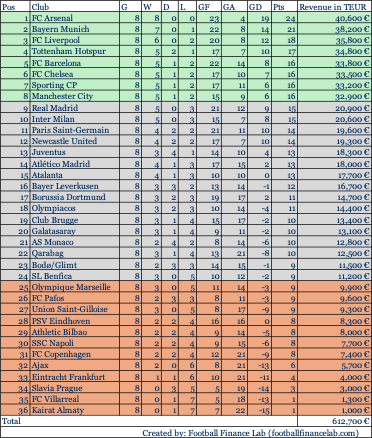
In the first part of this article, we will focus exclusively on performance-related bonuses in the league phase. In the league phase, each team receives €2.1 million for a win and €700,000 for a draw. For each draw, there is an additional €700,000, which is collected throughout the entire league phase and then distributed according to the respective league position. In addition, a bonus is paid out based on the final position in the league phase. Each unit is worth €275,000. The team at the bottom of the table receives one unit (€275,000), the team in second-to-last place receives two units (€550,000), and so on, until the team at the top of the table ultimately receives €9.9 million. But that’s not the only payment based on the league table. The teams ranked 1st to 8th qualify directly for the round of 16 and receive €11 million plus an additional €2 million performance bonus. The 9th to 16th place teams also receive an extra €1 million bonus and must compete in the intermediate round against the 17th to 24th place teams. A total of €612 million is distributed to the clubs during the league phase. The following table shows the resulting revenues, which are the same as the final table.
Total earnings breakdown: How entry fees, market pools and rankings shape club revenues
As described above in this article, total revenue consists of three pillars. We analysed performance-related bonuses in detail in the last section. In addition, each team that competes in the league phase receives a starting fee of €18.62 million. The value pillar distributes €853 million, almost as much money as the performance-related bonuses. The value pillar consists of two parts and is fed by the proceeds from the sale of TV rights to the Champions League. These are divided into the European and non-European parts of the marketing. The teams from the country that generates the most money from the sale of TV rights end up in the top places. The exact ranking is then determined using the 5-year ranking of the individual teams. The non-European part is distributed using the 10-year ranking of the respective clubs. In both pillars, the payout is calculated in shares, as described above for the placement payout. The last team in a pillar receives a share of the total amount paid out, the second-to-last team receives two shares, and so on, until the first-placed team receives 36 shares. In total, a team can receive a maximum of 62 shares and a minimum of two. If a team finishes first in both pillars, it receives over 40 million euros. A minimum sum of one million euros is guaranteed for a team that finishes last in both columns. As it is somewhat unclear which positions the respective teams will achieve in the two columns, we were unable to reliably calculate the total revenue ourselves. The following table therefore uses data from football365, converted and presented in a table.
Revenue analysis: Why Bayern lead the money table despite Arsenal’s perfect record
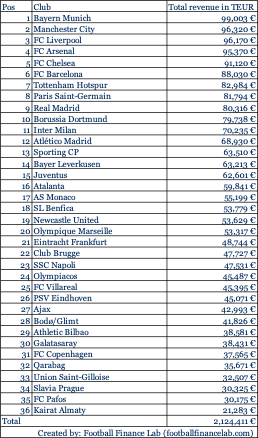
Let’s start by analysing the total revenue at the top of the table. Although Arsenal won all their league games, they are not at the top of the table in terms of total revenue. The German record champions are top of the table with approximately £99 million. This is most likely due to the fact that Bayern have participated in the Champions League every year for the last 10 years and have always reached at least the quarter-finals. Arsenal cannot achieve this consistency, which means that Bayern Munich receive more revenue in the value column. Although the large revenues generated by participation are often mentioned, there are also big differences within the competition. FC Bayern has earned almost five times more than Kairat Almaty, which is bottom of the league table with €21.2 million. Kairat is likely to be in last place in all columns, as this is the first time the club has participated in the competition and even the first time a Kazakh team has participated in the Champions League group/league phase.
The top five leagues dominate the revenue rankings. The top 12 places are occupied exclusively by clubs from the top five leagues. The lowest-ranked team is Athletic Bilbao in 29th place. A total of €2.1 billion has been distributed to the 36 clubs in the league phase so far. Of this €2.1 billion, approximately €1.54 billion goes to the 22 participants from the top five leagues, representing a share of 73%. The dominance of the Premier League is also evident in the top ten. Five of the six English participants are in the top ten in terms of total revenue. This is completed by two German teams (Bayern Munich, Borussia Dortmund), the two Spanish giants Real Madrid and FC Barcelona, and the only French team, Paris Saint-Germain. Surprisingly, there are no Italian teams in the top 10. Inter Milan is the highest ranked at 11th, just missing out on the 10 teams with the highest total revenues.
The sometimes significant differences between the sporting position in the league phase and the position in terms of total revenue are also interesting. Eintracht Frankfurt has made the biggest leap here. The third-placed team in the last Bundesliga season has been in a sporting crisis for weeks, which is reflected in the results in the Bundesliga as well as in the Champions League. The Eagles finished 33rd in the Champions League, but are 21st in the revenue table, 12 places higher than their sporting position. FC Villareal finished second from bottom in the league phase, but climbed 10 places to 25th in terms of total revenue. Borussia Dortmund also managed to jump from a slightly disappointing 17th place in terms of overall revenue to 10th place in the top 10. For all three clubs, this is due to their consistent participation and success in European competitions over the last 5-10 years. After all, Borussia Dortmund is last year’s finalist, and FC Villareal and Eintracht Frankfurt are the Europa League winners of 2021 and 2022. Qarabag has seen the biggest drop between sporting position and total revenue. The club from Azerbaijan sensationally qualified for the intermediate round and finished 22nd in the league phase. However, Qarabag is only in 32nd place in terms of total revenue.
Additional prize money ahead: Earnings potential in the knockout rounds and comparison to Europa League and Conference League
As the competition progresses, clubs can earn a lot more money with each round they advance. Teams receive €11 million for participating in the round of 16, €12.5 million for the quarter-finals, another €15 million for the semi-finals, €18.5 million for reaching the final and an additional €6.5 million for winning the Champions League. The Champions League winner will then receive an additional €4 million for automatic participation in the UEFA Super Cup. The Europa League winner will also receive this amount, and the winner of this match will receive an additional €1 million. The Champions League winner will thus receive an additional €67.5 million. In the two other European competitions, the Europa League will distribute €565 million and the Conference League €285 million. The Champions League therefore dominates the Europa and Conference Leagues by a huge margin in terms of distributions, which continues to result in the top European clubs and also the top five leagues pulling away from the other clubs. This makes it increasingly difficult for smaller clubs to compete and reduces the excitement of football (one example of this is the Bundesliga, whose capital structure we analysed in another article). The impact on league operations is clear in many leagues. In smaller leagues in particular, clubs that participate in the Champions League often earn many times more in CL revenue than other clubs can earn in their respective national leagues. It will be exciting to see how this develops over the next few years and how it affects the national leagues.


Pingback: Europa League prize money 2025/26: Full revenue breakdown
Genuinely when someone doesn’t be aware of after that its up
to other people that they will assist, so here it occurs.
Pingback: Juventus 2024/25 Finances: Revenue, Losses & Debt Analysis