


In one of our recent articles, we analysed the revenues of Champions League teams after the group stage in detail (click here for the article). The Europa League group stage ended one day later on Thursday last week. Let’s take a look at how much each club earned in the group stage and how big the difference is between the revenues of Europa League and Champions League participants.
How are Europa League revenues calculated? A breakdown of performance-based payments
UEFA will distribute a total of €565 million in the 2025/26 Europa League season, which is only about one-fifth of what is paid to clubs in the Champions League. This sum will be divided into three pillars. €155 million (27.5%) will be distributed equally among the clubs as entry fees. €198 million (35%) will be paid out as a so-called value bonus and €212 million (37.5%) will be paid to the clubs based on their sporting success.
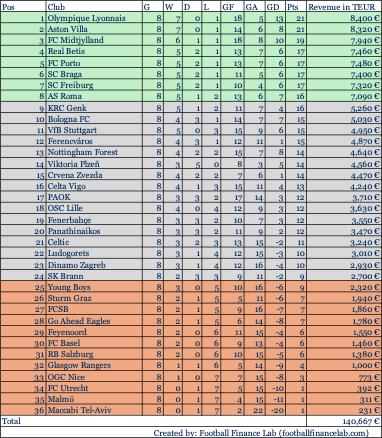
In this section, we analyse the performance-related bonuses exclusively for the league phase. In the league phase, each team receives €450,000 for a win and €150,000 for a draw. There is no remuneration for a defeat. This means that €150,000 remains for each game that ends in a draw. This amount is then added to the ranking remuneration. The remuneration based on the final position in the table consists of 666 equal shares. These shares start with an original value of €75,000. They are distributed to all teams in ascending order. This means that the last team receives one share (€75,000), the second-to-last team receives two shares (€150,000), and so on, until the top team in the table receives 36 shares (€3.1 million). All additional income from the unallocated remuneration from draws then increases the total amount and thus the 666 shares.
The teams ranked 1st to 8th in the final table qualify directly for the round of 16 and receive €600,000 in prize money for their placement and €1.75 million for qualifying for the round of 16. The 9th to 16th place teams must enter the intermediate round and receive €300,000 in prize money for their placement and an additional €300,000 as appearance money for the additional round. Teams ranked 17th to 24th also qualify for the intermediate round, for which they receive €300,000 in appearance fees only. The following table shows the resulting revenues, which are the same as the final table.
Total earnings explained: Entry fees, value bonuses and TV market distribution
As described above in the article, total revenue consists of performance-related bonuses and the two other pillars (starting money and value bonus). The entry fee is distributed equally to the clubs and each club receives 4.31 million euros. The value premium totals EUR 198 million. This €198 million is based on the money raised for TV marketing. It should be noted that the rights for the Europa League and the Conference League are marketed together, and this value represents only a split value. These EUR 198 million will be divided into two parts. The European part amounts to 73% of all TV revenue, which is 145 million euros. This EUR 145 million will be distributed to the 36 clubs (as is the case for remuneration after final placement) with equal shares. One share of this amounts to 217,000 euros. The ranking in this ranking is first determined from the TV revenues of the respective countries. If a country has several participants, their order is sorted according to the clubs’ UEFA 5-year ranking. For example, the two German participants, SC Freiburg, are ahead of VfB Stuttgart due to their higher ranking.
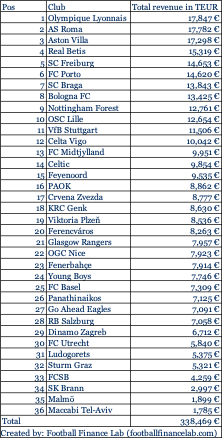
The non-European part is only 27% in the Europa League, which represents the remaining 43 million euros. These are distributed among the clubs according to a similar system. In total, the 43 million euros will be divided into 666 equal parts of 80,000 euros and then awarded again according to the ranking with ascending shares (the last one will receive another share, the second to last two shares, and so on). However, the distinction here is not made according to the revenues of the different countries, but is simply distributed according to UEFA’s 10-year ranking. If you now add up all the income from the three pillars, you get the following table with the total income of the clubs.
Which clubs earned the most? Full analysis of total Europa League revenues
As with the sporting results, Olympique Lyonnais ranks first in total revenue with 17.84 million euros. AS Roma follows with 17.78 million euros, which makes a big jump compared to success-based remuneration (from 8th to 2nd place). It is particularly interesting to see that in places 1-8 there are seven out of eight teams from the top 8 of the table. Although some of these positions have shifted among themselves, only FC Midtjyland is slipping in the compensation table. Despite finishing third in the final table, the Danes slipped 10 places to 13th. The dominance of the competition’s sportingly successful teams in the revenue table is particularly due to the smaller discrepancy between TV revenue compared to the Champions League, where the top 5 leagues dominate significantly more. In addition, the compensation for the round of 16, which only the eight best teams from the league phase have already received, weighs significantly more heavily than for the Champions League.
It is also interesting to see that clubs that achieve a passable place in the 5-year ranking can fall quite sharply due to the distribution according to revenue of the respective countries. SK Brann Bergen, for example, is only in 34th place in total revenue, although the Norwegians qualified for the intermediate round with 24th place. This also applies to Dinamo Zagreb, which fell from 23rd place to 29th. Clubs, such as. B. Celtic Glasgow, on the other hand, benefit from this because they shine through their stronger home markets. The Scots were able to jump from 21st place in the league table to 14th place in the total revenue table. City rivals Rangers are also being boosted by Scotland’s good performance in TV revenue. Rangers finished in a disappointing 32nd place in the league phase. In terms of total earnings, they make a big jump from 11 places to 21st place compared to their sporting performance. The biggest jump is made by Feyenoord Rotterdam with 14 places, which is due to the strong performance in the Dutch TV money revenue (among other things because they are the only nations besides France to field three teams in the competition).
Additional prize money and how the Europa League compares to the Champions League and Conference League
As the competition progresses, clubs can receive €2.5 million to reach the quarter-finals, €4.2 million to reach the semi-finals, €7 million to reach the final and a further €6 million to win the final. The winner of the Europa League will therefore receive an additional 19.7 million euros in addition to the money he has received so far (if the eventual winner has not yet qualified for the round of 16, he will also receive an additional 1.75 million euros).
The comparison with the other two European competitions clearly shows a financial three-tier society in the competitions. The 19.7 million euros available in the further course of the competition, for example, is only one million euros more than the starting bonus guaranteed for participation in the Champions League league phase. Especially in the overall distributions, it becomes clear how much the Europa League and the Conference League are dependent on the Champions League. With 2.5 billion euros, almost 5 times more is distributed in the Champions League than in the Europa League. However, with 285 million euros, the Conference League is also significantly behind the Europa League, which also distributes almost twice as much (585 million euros) as the Conference League. The gap between the top 5-dominated participants in the Champions League and the clubs in the Europa League/Conference League (in which significantly more clubs from smaller leagues are represented) is therefore enormous and thus also affects the financial inequality of the European leagues as well as within the European leagues.