


FC Barcelona has been struggling with high debts and financial problems for years. In this article, we analyze the balance sheet of the 2024/25 season and also look at the overall financial situation, including assets and debt, that Barca currently has. The analysis of last season’s balance sheet is important to show how the Catalans are currently moving financially and how the operational business compares to the high debt burden. We also look at the renovation of Camp Nous and its financial impact on FC Barcelona’s balance sheet and asset situation. Finally, we take a look at the budget Barca is planning for the current 2025/26 season and assess the overall financial situation.
Profit and loss breakdown: How Barcelona boosted revenues but still posted a net loss
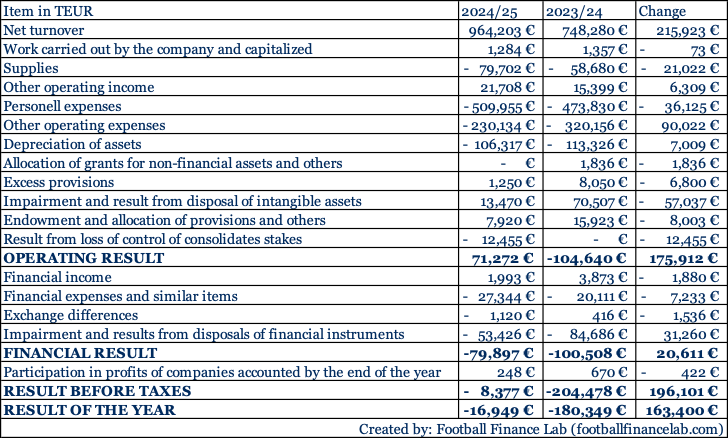
First, let’s take a look at the profit and loss statement for the 2024/25 season. Barca’s net operating revenue for the past season totalled €964 million. Compared to the previous season (€748 million), this represents an increase of €216 million. This represents a percentage increase of 28.8% and thus a massive growth. This growth is mainly due to two sources of income. Firstly, additional revenue of €32 million (from €86 million to €118 million) was generated through prize money in competitions compared to the previous season. These funds result from the sporting successes of the previous season, in which the club won the double of the Spanish championship and the Spanish Cup and advanced to the semi-finals of the Champions League. The second major source of income, which has risen sharply, is revenue from marketing and advertising. These advertising revenues rose from €378 million to €556 million, representing an increase of approximately 47%. This is a massive increase in advertising revenue, which is due to various reasons. FC Barcelona writes in its financial report that sponsorship revenue rose by 22% to €259 million. In addition, merchandising revenue rose to €170 million, which represents an increase of 55% over the previous year and is an all-time record. These two sources of income together account for 77% of all income from this sector. In addition, Barça was able to increase income from ticket sales, particularly for VIPs and the museum, by €47 million. Income from season ticket holders rose only slightly, by €2 million, and thus remained almost unchanged. The Catalans mention another interesting fact in their statement. According to this, the club is losing approximately €100 million in revenue due to the current stadium situation, as the Estadi Olímpic Lluís has significantly fewer seats (and hardly any VIP seats) than the Camp Nou. This loss was offset by additional revenue from sponsorship and merchandising. Total revenue amounts to approximately €994 million and is supplemented by ancillary income, other ongoing management income and disposals of intangible assets, representing the second-highest total of any football club behind Real Madrid for the past season.
The largest item of expenditure is personnel costs. These rose from EUR 473 million to EUR 509 million in the same comparison as the previous year, an increase of 7.6%. This represents approximately 51% of total sales, resulting in a very good percentage result. UEFA’s Financial Sustainability Regulations allow up to 70% of expenses for the team. Barca is therefore well below this figure. In total, the club spent 424 million euros on sports staff, which represents only 42% of total turnover and is used for UEFA’s valuation as it only relates to squad-related costs. A full explanation of how UEFA’s Financial Sustainability Regulations work can be found in this article. If you compare the squad costs with the value allowed by La Liga in the Squad Cost Limit, it is noticeable that this is undercut in both the summer and winter transfer windows. Barca has reported La Liga Squad Costs of €426 million and increased them to €463 million in the winter transfer window. This seems a bit incomprehensible, since even with the value from the summer transfer window it would not have exceeded it. An overview of this year’s Squad Cost Limits for Barca and the other La Liga clubs, as well as an explanation of how they work, can be found here. €60 million was spent on non-sporting personnel.
The second major cost point, apart from personnel costs, is other operational expenditure amounting to EUR 230 million. FC Barcelona was able to reduce this by 90 million compared to the previous season (28% of the previous year’s figure). External services account for the largest share at EUR 143 million. In addition, 44 million euros in additional management costs are added as a second major part. The last large part is depreciation of assets. These amount to EUR 106 million and thus fell slightly by EUR 7 million compared to the previous year. These consist largely of write-offs of players’ rights amounting to 81 million euros. This is a normal value for a club like Barca, as transfer fees for players are not fully allocated to the year of signing in accounting terms, but are written off in the same amount over the term of the respective player’s contract. In total, FC Barcelona is making an operating profit of 71 million euros. This shows that Barca has very good numbers in operations and is highly profitable. The comparison with the previous season also shows a significant increase, as a large loss of 104 million was reported in the 2023/24 season.
While the numbers in operations look very good, the overall result no longer looks quite so rosy. Due to financial burdens and taxes, the total result amounts to a loss of 16 million euros. This is mainly due to the financial burden of 79 million euros, which alone consumes the entire operating profit. These consist of financial charges due to interest charges amounting to approximately EUR 27 million and additional losses due to impairments in the value of financial investments in group companies amounting to EUR 53 million. Interest expenses increased by 35% last year and resulted from the high debts and loans that Barca has due to the renovation of Camp Nous. The remaining impairments of group companies probably result from the sale of rights to the subsidiary Barca Produccions SL, which was recently necessary to ensure FC Barcelona’s solvency. We analyse the current debt situation as well as the overall financial situation in the next paragraph.
Debt vs. Assets: A deep dive into Barcelona’s €2.42 billion liability mountain
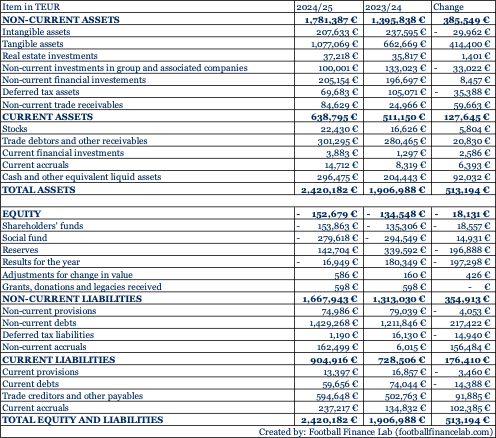
FC Barcelona’s debt situation is a recurring topic in the media and weighs heavily on the club’s operating results, as we have already analysed. While the club continues to post elite figures in its operating business, the figures for debt and assets paint a very different picture. Overall, FC Barcelona has debts of €2.42 billion, offset by assets of the same amount. The debts are divided into short-term and long-term debts. Short-term debts amount to €904 million, which represents a massive increase of €176 million (24% from €728 million in the previous season). Short-term debts consist of four items. The largest item is trade payables and other liabilities. These amount to €594 million and consist of debts to suppliers, other clubs, sports personnel (presumably outstanding player salaries) and other debts to public authorities. Liabilities to other clubs rose from €45 million to €140 million, which is attributable to outstanding transfer fees for new signings during the season. The second largest item is current provisions, which rose from €134 million to €237 million. The remaining items are current liabilities and current commissions, which make up the short-term liabilities with €59 million and almost €14 million respectively.
Long-term debt stands at €1.67 billion, accounting for the lion’s share of total debt. This rose by 27% (approx. €360 million) compared to the previous season, when it stood at €1.31 billion. This can also be broken down into four items. The largest portion is long-term debt amounting to €1.43 billion. This consists mainly of other financial liabilities, which probably relate to liabilities in connection with the stadium renovation. These rose from €523 million to €891 million, a massive increase of 70%. Long-term debt is also made up of bonds and other market-standard solutions amounting to €499 million. These were even reduced by €28 million compared to the 2024/25 season. The second largest item is long-term provisions, which amount to €162 million. The last two items are long-term commissions and deferred tax liabilities. These amount to €74 million and €1 million.
Equity usually provides a positive balance for debts, but FC Barcelona is also severely affected in this area. Barca’s equity is negative and contributes a further €152 million to its debt. Although the Catalans have reserves of €142 million, these are offset by shareholder funds of €153 million alone. Put simply, shareholder funds are the assets that remain after all total liabilities have been deducted from the assets. This figure also highlights the severe financial instability Barca is struggling with. In addition, social funds amounting to €279 million are reported, which also have a negative impact. Social funds are earmarked financial resources that are usually allocated to organisations or companies committed to social justice. It is difficult to speculate on the origin of this sum.
The liabilities are offset by assets of the same amount, as described above in this article. These rose by the same amount as FC Barcelona’s total debts. These assets are also divided into current and non-current assets. Long-term assets account for the larger part of Barca’s assets, at €1.78 billion. These long-term assets are divided into seven items. By far the largest part of these are tangible assets, amounting to approximately €1.08 billion. These are divided into several sub-items, only two of which are relevant. Stadiums and arenas are reported at a value of €62 million. This figure may seem surprising at first, as one would think that it would be particularly high due to the renovation of Camp Nous. However, these assets are reported separately in Barca’s balance sheet under property, plant and equipment in progress at €973 million. These rose by €421 million, or 75%, compared to the previous year. Furthermore, FC Barcelona has intangible assets amounting to €207 million, which relate almost exclusively to sporting intangible assets (rights to player purchases) amounting to €188 million. Another major item is long-term financial investments, amounting to €205 million. These consist largely of €159 million in equity instruments (direct company investments with residual value claims) and €37 million in outstanding payments from other sports organisations (possibly other clubs that have not yet settled transfer fees). In addition, FC Barcelona has €100 million in long-term investments and participations in affiliated companies. The remaining three items are trade receivables of €84 million, deferred tax assets of €69 million and real estate investments of €37 million.
Current assets total €638 million. These are divided into five items, the two largest of which are trade debtors and other current income, as well as cash and other liquid assets. Funds from trade debtors and other short-term income amount to €301 million and include, among other things, short-term assets from other sports organisations amounting to €64 million and other debtors amounting to €186 million. Cash and other liquid assets amount to €296 million. The remaining three items consist of stocks (€22 million), current provisions (€14 million) and current financial investments (€4 million).
Cash flow analysis: Rising liquidity amid massive Camp Nou investment costs
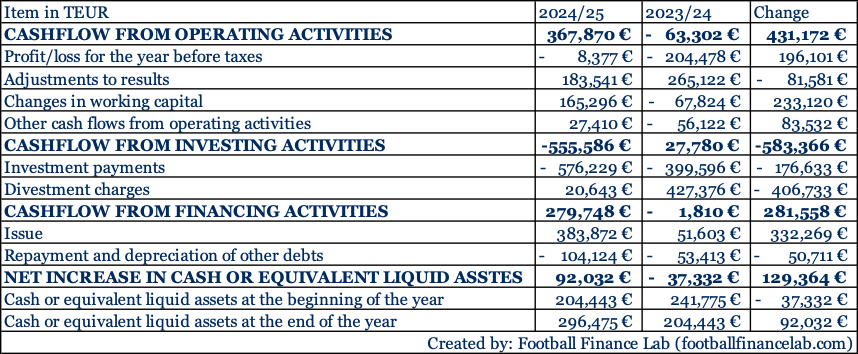
At the end of the last paragraph, we showed cash and liquid assets of €296 million in FC Barcelona’s statement of financial position. In this paragraph, we explain how this sum was arrived at and analyse the club’s cash flow. Compared to the previous year, total cash flow rose by 45% from €204 million. The cash flow is divided into three items in the balance sheet. The first item is cash flow from operating activities. Here, Barça recorded a surplus of €367 million. This is a massive increase compared to the previous season. In the 2023/24 season, FC Barcelona still had a deficit of €63 million. Operating cash flow consists of various sub-items. This includes a loss of €8 million from the income statement, which, however, is significantly improved by adjustments to the income statement results, amounting to €183 million. This is mainly due to depreciation of assets amounting to €106 million. However, the biggest change is in net working capital. In the previous season, the Catalans recorded a loss of €67 million, while this season they recorded a gain of €165 million. This is due to the provisions Barca made this season (€258 million). These provisions are strongly linked to the construction of the new Camp Nou stadium. The last sub-item is the additional cash flow from operating activities.
In contrast, FC Barcelona recorded a significant loss of €555 million in cash flow from investing activities. This is mainly due to the costs incurred for the renovation of Camp Nou, which are listed under intangible assets at €472 million. The remaining portion is mainly attributable to expenditure on sporting assets (expenditure on player transfers) at €90 million. The last item is cash flow from financing activities. This brings Barca a further €279 million. This figure is so high because it shows how much cash flow FC Barcelona was able to generate with the help of loans or other external financial instruments. This can also be seen very clearly in the sub-items listed. Barca took on €383 million in new debt. €104 million was paid off in existing debt. Overall, total cash flow increased by €92 million during the 2024/25 season.
25/26 Budget outlook: Revenue growth expectations and the long‑term financial risks ahead
FC Barcelona’s budget anticipates an increase in revenue to €1.075 billion, which would represent an increase of 8% (€81 million). Barca hopes to achieve this increase in revenue with the return to Camp Nou, which is expected to generate €50 million in additional income from the museum, ticketing and VIP services. In addition, they are forecasting a €70 million increase in advertising revenue and a €10 million transfer surplus. They are also planning for a €9 million decline in media/TV revenue and other extra expenses of €40 million. FC Barcelona also expects expenditure to rise from €964 million to €1.019 billion. This is due to rising salary costs (an increase of €31 million) and rising management costs (an increase of €53 million), which are explained by increased expenditure due to the return to Camp Nou.
Overall, it can be said that Barca is achieving very good figures in its operating business and the strong increase in annual results is a good sign that the club will be in the black in the short term. Another positive factor is that FC Barcelona has a positive cash flow, which has also risen sharply. This increases liquidity and rules out short-term financial problems for the time being. However, there are still alarming signs in Barca’s balance sheet. Expenditure on Camp Nou is skyrocketing, amounting to €476 million in the past season. These high construction costs are placing an enormous strain on the Catalans and ensuring that they are heavily burdened with investments, especially in the long term. The construction is being financed almost exclusively by debt capital, which makes the club particularly dependent on external ‘cash suppliers’ such as banks or other lenders. It can therefore be said that FC Barcelona is a very healthy club overall in terms of its operating business and generates good revenues, but the club is taking a big risk with the stadium renovation (especially due to the type of financing via debt capital). Barca is putting all its eggs in one basket, and that basket is called Camp Nou. If it succeeds in financing the renovation with external capital and this guarantees significant additional income in the future, Barca will have a huge competitive advantage over other clubs. If they do not succeed, the club will be bankrupt and unable to pay off its extreme debts, which would either mean that Barca would have less money at its disposal or could only be saved from dissolution by political intervention. We will see what happens in the next few years and whether FC Barcelona manages to pay off its extreme debts of €2.4 billion, or whether external changes destroy the club and its risky approach. Barca’s strategy is based on a high risk, high reward approach. We can look forward to seeing whether it pays off.

Pingback: Juventus 2024/25 Finances: Revenue, Losses & Debt Analysis