


This article contains affiliate links. If you purchase through these links, Football Finance Lab may earn a commission at no additional cost to you.
Juventus Turin has been experiencing difficult times in sporting terms since the 2019/20 season. This season, the Italian record champion celebrated his last championship after 9 championships in a row. After that, Serie A experienced four different champions in 5 years, not even the title going to Turin. In this article, we look at whether Juventus is also going through difficult times financially or whether the numbers are looking better than on the pitch. For this purpose, we will analyze the annual financial statements of the 2024/25 season, taking a closer look at the income statement, the overall financial situation with assets and liabilities, and cash flow.
Revenue breakdown 2024/25: How Juventus boosted income but still posted heavy losses
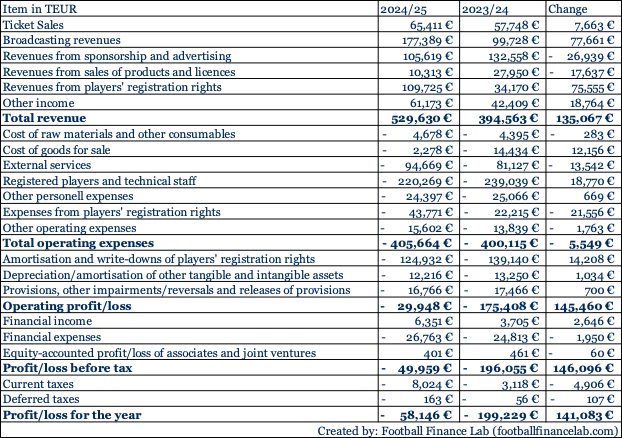
In total, Juventus recorded sales of 529 million euros in the 2024/25 season. This represents an increase of approximately 34% compared to the previous season, when Juve had a total turnover of 394 million euros. This massive increase is mainly due to the sharp increase in revenue from TV marketing. Revenue increased from €99 million to €177 million, which can be explained by participation in the Champions League in the 2024/25 season, while Juventus did not participate in European business in the 2023/24 season due to a UEFA penalty. They recorded €67 million in revenue from UEFA competitions alone. An analysis of the earnings of this year’s Champions League participants can be found here. In addition, a further 27 million euros were generated from FIFA competitions, which represents the revenue from the Club World Cup. Although this took place after the season, it falls within the last financial year, which ran from July 1, 2024, to June 30, 2025. The second category in which Juve saw a sharp increase was revenue from player registration rights. This term sounds a bit complicated and incomprehensible, but it is easy to explain. This figure represents revenue from player transfers. Juve raised €90 million, an increase of €67 million from €23 million. The old lady made the most of the sale of Matias Soule to AS Roma, with approximately 22 million euros. Ticket sales also saw a slight increase of €8 million (from €57 million to €65 million), also related to the additional Champions League matches. Other revenue also increased from EUR 42 to EUR 61 million. This is mainly related to the adjustments of estimates in the balance sheet (EUR 6 million) and insurance compensation amounting to EUR 5.5 million.
However, two categories of revenue also fell compared to the previous year. Advertising and sponsorship revenue fell by €27 million, from €132 million to €105 million. This was because Juventus did not have a shirt sponsor for a time and was therefore unable to record any revenue in this area during this period either. In addition, revenue from merchandising and licensing fell from 28 to 17.5 million euros (loss compared to 10.5 million euros). Juve explains this in its balance sheet with the contract signed on June 24, 2024, with Fanatics, which will largely take over merchandising. As a result, Juventus generates less revenue, but spending also fell sharply (degression by 12 million euros), which meant that Juve was able to earn 1.5 million euros more in this area year-on-year.
Operational costs were €405 million and increased only very moderately by €5 million (originally €400 million). Spending on players and coaching staff was even reduced by a whopping 19 million euros (from 239 to 220 million euros). At the same time, however, spending on player transfers doubled from 22 to 44 million euros, resulting in even 3 million euros more being spent in the area of player spending than in the previous season. External costs also increased from 81 to 94 million euros. According to Juventus, this is due to the return to the Champions League and participation in the Club World Cup and the associated higher costs for organization, stadium use and transport costs. It was also noted that although the cost of Legal increased by EUR 3 million, this also enabled EUR 4 million more to be generated through insurance claims. We had already explained the reduced expenditure on goods for sale of EUR 12 million in the previous paragraph with the new contractual relationship with Fanatics.
Overall, the figures sound like a healthy operational business, but Juventus is recording a total of 154 million euros in additional costs in three additional categories. This includes a loss of EUR 30 million from a profit of EUR 124 million from pure operating business, including all special expenses in operating business. This is mainly due to depreciation and value adjustments of player values amounting to 125 million euros. These write-downs even fell by EUR 14 million in comparison with the previous year. This improvement is strongly related to the fact that Danilo returned to Brazil and Douglas Luiz was transferred to Nottingham Forest, meaning that no further losses of his value appear on the balance sheet. Depreciation for material values was approximately 12 million euros (down by one million euros compared to the previous year), which represents depreciation for the stadium and the training ground. Commissions of approximately 17 million euros are also part of the balance sheet, which also remained almost the same compared to the previous year and fell by one million euros. The majority of these commissions represent severance payments for separations of players or staff members, which is due, among other things, to the separation from former coach Thiago Motta.
In addition to the loss of approximately 30 million euros in operational business, there are further losses, so that the total loss for last season is 58 million euros. This is actually a sharp increase compared to the previous season, as 199 million losses were made during this season. The additional EUR 28 million loss to the operational loss can be divided into three categories. The first two categories amount to approximately 20 million euros and, together with the loss from operating business, describe the loss before taxes, which amounts to 50 million euros and is therefore very different from 2023/24 (196 million euros loss). Juventus was able to earn 6 million euros from discounting, but also suffered losses of 26 million euros in financing its ongoing business. Juve justifies this with an increasing financial burden when buying new players with long-term payment terms. These provide for a recalculation of liabilities and thus a higher interest burden. In addition, Juventus paid €8 million in taxes last season, which was €5 million more than the previous season. The following table provides an overview of the profit and loss statement for the 2024/25 and 2023/24 seasons.
If you want to understand the financial mechanics behind revenue, transfers and club economics, Soccernomics is one of the most insightful books on football finance.
Assets vs. Liabilities: The True Scale of Juventus’ Debt and Financial Exposure
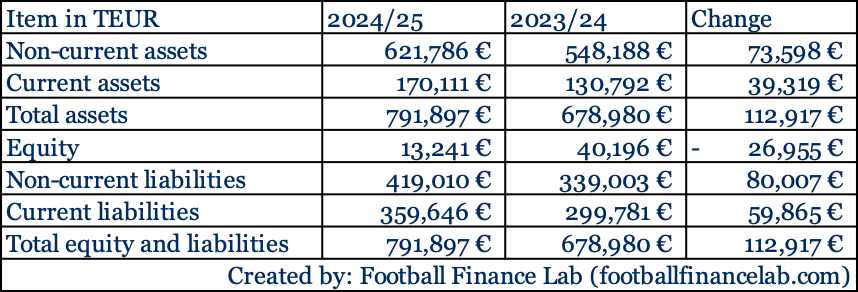
After analyzing Juve’s current finances last season, let’s now look at the entire financial situation, including all of the old lady’s assets and debts. The assets are divided into two main categories: short-term and long-term. The long-term assets amount to approximately EUR 622 million. The largest part here is the player registration rights with 323 million euros, which represents the squad value. This increased by 49 million euros compared to the previous season from the original 274 million euros. There are also three other major main parts. One of these is the remaining intangible assets with 55 million euros. Juventus explains that these mainly come from the value of the Juventus Library. Juve includes the archive of all historical television images of the club. These were then recorded at cost price and are checked annually for depreciation. The other two main points are land and buildings worth 162 million euros and claims on other clubs from transfers worth 57 million euros, which represents a sharp increase of 42 million euros over the previous year. The land and buildings include, among others, the value of the Allianz Stadium, the training ground and the office.
Short-term assets are significantly lower at approximately €170 million. The majority of these assets, at €47 million, are again receivables from other clubs for transfers. These have more than doubled compared to the previous year (by 25 million out of 22 million euro). Another part is claims for benefits and supplies amounting to 42 million euros, which largely comes from participation in the FIFA Club World Cup. In addition, Juventus still has 36 million euros in liquid assets and 22 million euros in short-term assets. A more detailed analysis of this can be found in this article in a later cash flow analysis. In total, Juve records assets of 792 million euros. These thus increased by EUR 114 million out of EUR 678 million.
The old lady’s liabilities can also be divided into short-term and long-term. The long-term liabilities amount to EUR 419 million. These are mainly composed of two main parts. The largest part is loans and debts worth 283 million euros, which increased by 36 million euros. In addition, Juventus will have to pay 109 million euros to other clubs for transfers in the long term. These have more than doubled compared to the last cut-off date of EUR 52 million. The short-term liabilities are spread across a large number of positions. The two categories of long-term liabilities in the short term are also considered: 56 million euros in loans and debts and 115 million euros in transfer claims from other clubs to Juventus. In addition, 31 million in receivables from supplies and services appear as major positions. In addition, EUR 101 million in other liabilities and EUR 40 million in advances are still due. In total, Juventus has approximately 360 million euros in short-term liabilities. This will result in a total of EUR 779 million in liabilities.
Equity is also shown here, which shows a positive amount of 13 million euros. This fell by 27 million euros and was more than halved compared to the previous year. This was due to the loss of EUR 58 million and could only be kept positive by EUR 30 million in payments for future capital increases. A method that Juventus used in a similar way last year to contain the loss of 199 million euros. For this purpose, a capital increase of the same amount was carried out through share capital. For this, Juventus sold 126 million shares at a price of 1.582 euros. Overall, liabilities and assets are balanced and both stand at EUR 792 million. This is also the case with FC Barcelona’s record, whose record from last season we have analyzed in this article. In the following table you will find a comparison of assets and liabilities.
Cash Flow Analysis: Why Juventus’ Liquidity Remains Under Pressure Despite Higher Revenues
In total, Juventus has a total cash flow of 36.5 million euros. This increased by only 164,000 euros. The operating cash flow is EUR 25 million, which increased significantly year on year. In the previous season, this 46 million euros was negative. Thus, operating cash flow increased by EUR 71 million. This is mainly because Juve was able to reduce the operating loss from 199 million to 58 million euros. However, at the same time, losses for registering players increased from 23 million to 89 million euros. In addition, depreciation increases in value fell by 15 million euros. Investment cash flow also declined significantly. This was -33 million euros last year, while this season it was -96 million euros. This was particularly due to the extremely increased investment in players, which rose from 99 million to 216 million euros. At the same time, revenues from player sales were also significantly increased, rising from 32 million to 132 million euros. The financing cash flow, on the other hand, increased slightly from EUR 67 million to EUR 71 million. This ensures that the overall cash flow is slightly positive. For this purpose, 30 million euros in payments for future capital increases and a further 40 million euros in new debt were brought in. The following table lists the cash flow figures.
Many fans use a secure VPN to access international football streams and protect their data online. It’s a simple way to watch matches safely from anywhere. You can do this safely with NordVPN and change your virtual location safely. The service offers fast speeds, stable connections, and works seamlessly with major streaming platforms.

Conclusion: Juventus Must Fix Depreciation Losses and Secure Champions League Revenue to Survive
Overall, it can be stated that Juventus is in a very difficult financial situation. This is particularly evident in the losses from operational business, which amounted to 58 million euros and resulted mainly from the depreciation of player values. However, this also shows that Juve is on the right track towards profitability, as the loss has been significantly reduced compared to the previous year (in 2023/24 it was still 199 million euros in loss). However, Juventus remains in a difficult financial situation, as further figures make clear. Cash flow did not increase and was only 36 million euros, which is also not a high figure (FC Barcelona recorded cash flow of 296 million euros last season). In addition, the equity ratio is very low, which makes Juve very dependent on external investors. This was only 1.7% and, through debt financing, is driving the external debt burden and, with it, the interest burden further upwards. This is further confirmed by the analysis of equity. This shows that Juventus only has equity of 13 million euros and that this has only remained positive, as 30 million euros in payments for future capital increases have been made. Juventus is therefore dependent on external investors offsetting losses from current years through capital increases in order to keep the club economically stable. In conclusion, Juventus urgently needs sporting success in the form of qualification for the Champions League to continue to contain its loss. In addition, Juventus urgently needs to get the high depreciation of player values under control, which can only be achieved through smart transfers and the further development of players in the squad