
This article contains affiliate links. If you purchase through these links, Football Finance Lab may earn a commission at no additional cost to you.
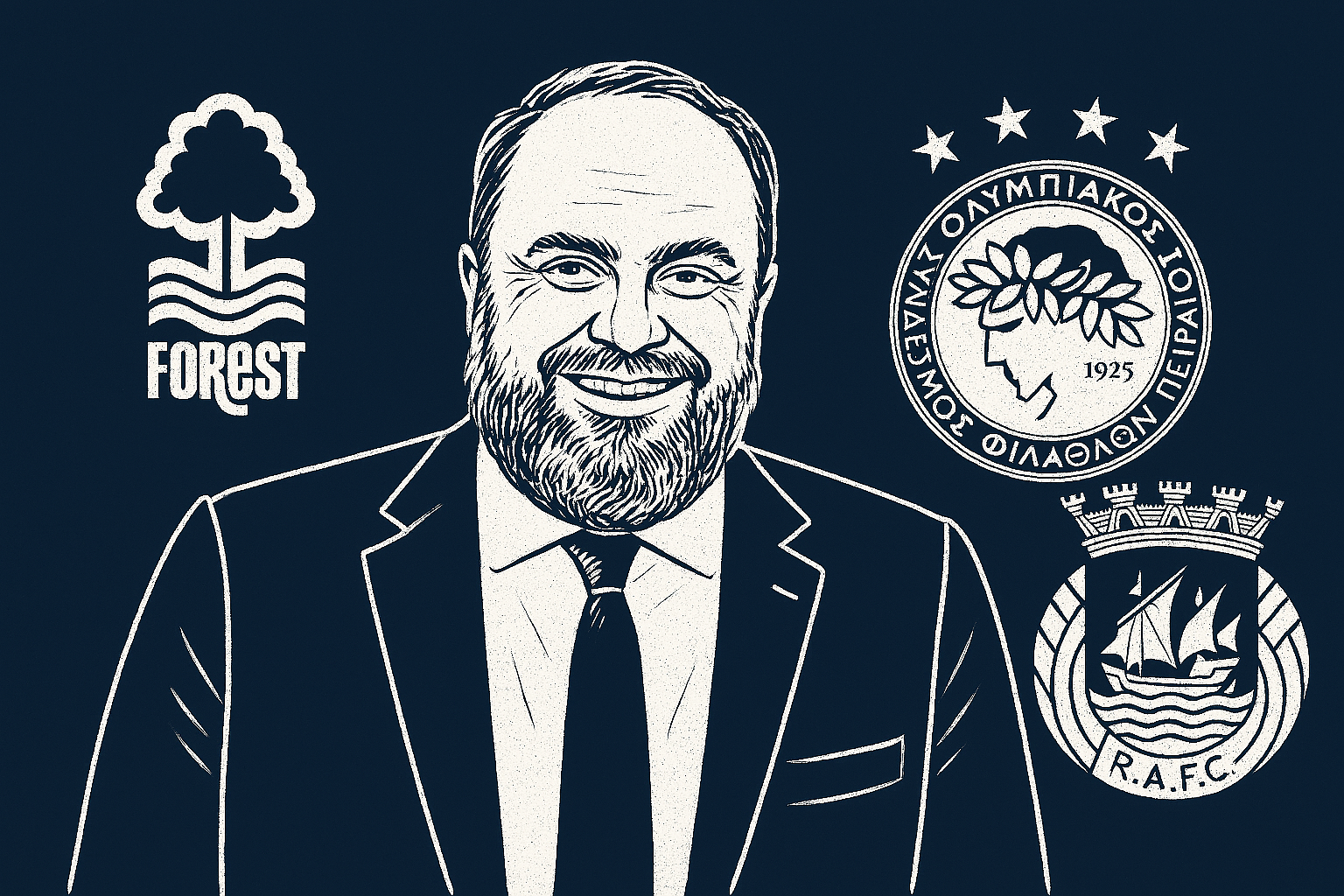
According to his Forbes profile, Evangelos Marinakis and his family are the 557th richest people in the world (as of today) with a fortune of €6.03 billion. The Greek businessman has earned his fortune in two ways. He is the owner of Capital Maritime Trading Corp., a private logistics company. He is also a media entrepreneur and the main owner of three football clubs. These include Olympiacos Piraeus, Nottingham Forest and Rio Ave FC. In this article, we analyse Marinakis’ ownership structure and how it affects the clubs and the connection between the clubs in his multi-club ownership. A detailed explanation of multi-club ownership can be found here.
Ownership Structure of the Marinakis Football Network
Before we delve deeper into the relationship between the clubs, let’s first explain Marinakis’ ownership structure in relation to the clubs. The first club he bought was Greek record champions Olympiacos Piraeus. In 2010, he acquired 67% of the club from Greek entrepreneur Sokratis Kokkalis for €50 million. This gave him a two-thirds majority in the club and, from 2010 onwards, decision-making power at Olympiacos. He has been president of the club since the purchase. In May 2017, Marinakis went one step further and bought the traditional English club Nottingham Forest from Fawaz Al-Hasawi. Together with his partner Sokratis Kominakis, he acquired 100% of the club. According to various sources, the price at the time was around €57 million, which was only marginally higher than the price for the acquisition of Olympiacos. This was due to the precarious situation Forest found itself in at the time. They had just managed to avoid relegation to the third division and had enormous debts as well as a stadium in need of renovation, including outdated infrastructure at training grounds and other club properties.
In 2019, he bought the third and currently last club in his multi-club ownership, Rio Ave FC from Portugal. At the time, this club was also struggling with financial difficulties. The number of shares and the exact purchase price are not known. However, he will have acquired a majority of the shares here as well, thus establishing a multi-club ownership with a clear goal and hierarchy. It is clear that Nottingham Forest, as a Premier League team and the financially strongest club, is at the top of his MCO, followed by Olympiakos, another successful club in a weaker league, and finally Rio Ave FC, a club that operates in one of the strongest training leagues. We will discuss the connections between the clubs later in the article, but first let’s look at Marinakis’ takeover and rebuilding of Nottingham Forest.
Nottingham Forest Takeover and Strategic Rebuild
When Marinakis took over Nottingham Forest in 2017, they finished the 2016/17 season in 21st place in the Championship, level on points with Blackburn Rovers, who were relegated to the third-tier League One due to their inferior goal difference. Forest was thus in a sporting crisis, but financial problems were also weighing heavily. They only ended the season with a profit because Marinakis converted €46 million in debt into assets, thus ensuring a pre-tax profit of €36 million. The club ended the season with an operating loss of €26 million. This shows how bad the club’s finances were. In the years following the takeover, the club continued to make operating losses, but these were offset each year by Marinakis converting loans into equity.
The reason why Marinakis has done this time and again is simple. He is not a secret fan of Nottingham Forest, but rather sees the club as an investment. This is particularly evident when looking at the development of transfer spending. In the years following the takeover, this remained constant at between €8 million and €28 million. The club also climbed steadily in the league table, from 21st place in 2016/17 to 7th place in 2019/20. After slipping to 17th place in the 2020/21 season, Nottingham Forest finally qualified for the promotion play-offs again with a 4th place finish in the following season. On 29 May 2022, the Tricky Trees secured their return to the Premier League after a 23-year absence with a 1-0 win over Huddersfield. The return was accompanied by a massive windfall from the Premier League’s lucrative TV revenues. This was then reflected in Forest’s transfer spending. In their first season, they spent €198 million on transfers, followed by €131 million and €105 million in the following years. In the current season, Nottingham Forest has spent a record €241 million. An analysis of transfer spending in the top five leagues in the 2026 winter transfer window can be found here. However, the promotion is not only associated with increased transfer spending, but also with increased revenue and (most importantly for Marinakis) a significant increase in the club’s value. Within five years, Evangelos Marinakis has managed to turn an indebted second division club into an established Premier League club that even competes internationally.
Inter‑Club Connections: Transfers, Pathways and Hierarchy
The connection between the clubs is not as strong as is typically the case with multi-club ownerships. There are transfers between the clubs, but not on the same scale as, for example, Chelsea FC and RC Strasbourg within the Blue Group. Since the takeover, Nottingham Forest has signed nine players from Olympiacos and transferred 12 players to them. There were also four transfers between Nottingham Forest and Rio Ave. In addition, there were 16 transfers between Olympiacos and Rio Ave FC, with Rio Ave signing the majority of players from the Greek club. The connection between Rio Ave and Olympiacos is much closer at player level, which is probably due to the strength of the respective leagues. The Premier League is considered the strongest league in the world, while the Greek Super League and the Portuguese Liga Portugal operate at a similar level. Overall, Nottingham tends to operate more independently, while the partnership between Rio Ave and Olympiacos is closer.
If you want to follow Olympiacos, Nottingham Forest or Rio Ave matches from abroad, a reliable VPN is essential. With NordVPN you can securely access international football streams and protect your data while browsing.
Conclusion: Marinakis’ Investment Strategy and the Future of His MCO
Evangelos Marinakis and his multi-club ownership are an example of an investor who sees his holdings as an economic investment with the hope of high returns. At Olympiacos, he even acts as president and pursues this calling with great passion. He was one of the main defendants in the Greek match-fixing scandal and is alleged to have planned a bomb attack on a referee’s bakery. He is a controversial figure who makes use of the critically viewed system of multi-club ownership. However, he has used this system very successfully so far, ensuring sporting success and a significant increase in the value of the club, particularly at Nottingham Forest. In conclusion, it will be interesting to see how Rio Ave FC continues to develop under his ownership (Nottingham Forest and Olympiacos Piraeus have enjoyed great success under him so far) and whether he will expand his network of clubs and intensify cooperation between them. So far, the clubs have operated almost entirely independently and have hardly acted in the hierarchy otherwise familiar from MCOs, although transfer movements between Olympiacos and Rio Ave continue to increase.