
This article contains affiliate links. If you purchase through these links, Football Finance Lab may earn a commission at no additional cost to you.
The TV money distribution will be published by the Premier League immediately after the end of the season. Revenue from TV marketing represents the largest source of revenue for clubs. In this article, we explain how TV revenue is distributed among Premier League clubs and what each club earned from it last season. In principle, TV money is divided into three sources of income. Revenue from marketing in the UK, international marketing and other advertising revenue, which is summarized under Commercial. In addition, the Premier League is launching further attempts to generate additional revenue in TV marketing by testing its own streaming service in Singapore (you can find the article here).
How the Premier League distributes its domestic TV revenue
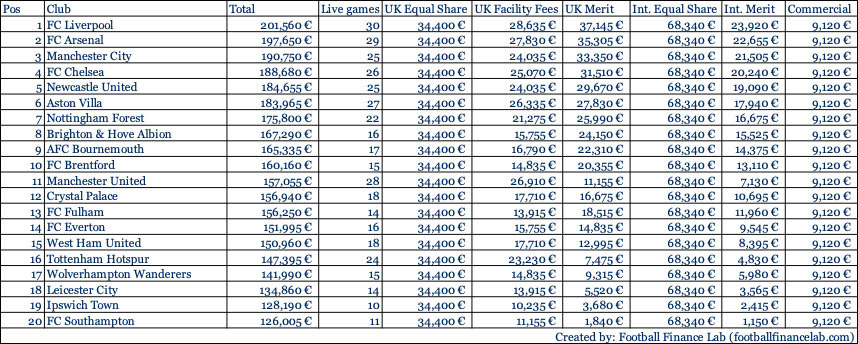
In total, the Premier League distributed €1.47 billion to its clubs from UK’s TV marketing. This sum is divided into three parts. 688 million euros will be distributed to the clubs in equal part. Each club will receive 34.4 million euros in the same amount. The other two parts amount to 391 million euros. One part refers to the number of live games. However, the 391 million euros available will not be divided by the 400 live games. Instead, clubs receive compensation based on the number of live matches they play, depending on their ranking. Ipswich Town received the least here, with just €10.27 million. While champions Liverpool FC received 28.75 million euros for 30 live matches. The other part is based on the table ranking. This is divided according to equal proportions in ascending order per placement. One share is 1.85 million euros, which the bottom team receives, the second to last team receives two shares (3.7 million euros), the third to last team receives three shares (5.55 million euros) and so on until the champions collect 37 million euros.
Revenue from international TV marketing totals EUR 1.61 billion. However, these will only be divided into two further parts. One part consists of an equal part, where each club receives 68 million euros. In total, all clubs will receive 1.36 billion euros. The other part is based on the final ranking in the table. The clubs will receive a total of 250 million euros. This is remunerated with shares. One share of this amounts to 1.15 million euros. The last of the final table receives one share, the second to last two shares and so on until the champion receives 20 shares, which represents 23 million euros.
Revenue analysis: What each Premier League club earned from TV money
The Premier League has distributed a total of 3.27 billion euros to its clubs. In addition, a further 628 million euros will be paid out to English amateur football from the TV revenue. Overall, it can be seen that the Premier League distributes the funds largely according to sporting successes. However, the big 6 teams are repeatedly pushed hard by the proportion of their live games. For example, despite finishing 15th in the final table, Manchester United finished 11th in the revenue table. This is because Manchester United had the most live games in the previous season, behind champions Liverpool FC (30) and runners-up Arsenal FC (29). Despite 24 live matches, Tottenham Hotspur only made one jump from one place compared to the final sporting table. In general, the distribution of live matches varies greatly between clubs. The teams fighting against relegation have received the fewest live matches, the teams from the middle of the table tend to receive a little more, and most have gone to the Big 6, which is due to their popularity and large fan base.
As champions, Liverpool FC receives the most from TV revenue, with around 201 million euros. Which is 75 million euros more than last-placed Southampton FC. In percentage terms, the champion differs by 59% more than the bottom team. This is a fair distribution. In the Bundesliga, champions FC Bayern Munich received 3 times more than bottom-placed Holstein Kiel. The differences within the Bundesliga become particularly clear for all relevant financial indicators, which you have already highlighted in this article. This is ensured by the large proportion of equal distribution for both sources of income (UK, International and Commercial). In addition, only one metric (number of live games) is not based on the final table for the total distribution. In the table below you can see the exact numbers per club.
For readers interested in how data, strategy and financial resources translate into on‑pitch success, Ian Graham’s book How to Win the Premier League offers a rare inside look into the analytics behind elite football. It’s an excellent resource for understanding how clubs turn investment, squad planning and performance data into competitive advantage.