


Deadline Day in the top five leagues is over, and compared to previous years, it was literally dead. In this article, we will analyse the transfer activity that took place in the top five leagues, look at how much each league spent in total, and shed light on the background to these transfers. The following table shows the income, expenditure and number of players who changed clubs. The data was provided by Transfermarkt and compiled, analysed and tabulated by Football Finance Lab.

Transfer spending and signing volume: How Europe’s big five leagues invested in winter 2025/26
Unsurprisingly, the Premier League spent the most of all leagues. With approximately €453 million spent on winter transfers, the Premier League accounted for almost half of the total transfer spending of all top five leagues. In total, the top five leagues spent €975 million. This clearly demonstrates the financial dominance of the Premier League. In second place in terms of spending is Serie A with €243 million, which is almost half of the Premier League’s spending. The Bundesliga and Ligue 1 follow with €101 million each, and La Liga comes in last with €75 million. With approximately €278 million, the three leagues spent almost as much as Serie A. The differences between the leagues in this transfer window are therefore significant.
The fact that Serie A is in second place, far behind the other leagues, is also due to the sheer number of transfers. There were a total of 142 new signings in Serie A. That is roughly the same number as the Bundesliga and Ligue 1 combined (72 new signings each). The league with the lowest expenditure, La Liga, had the fewest new signings with 57. It is interesting to combine these figures with the transfer expenditure explained in the previous paragraph. On average, it can be seen that all leagues except the Premier League are at a similar level. La Liga spent the least, at €1.42 million per transfer. This is followed by Ligue 1 and the Bundesliga, at €1.4 and €1.42 million respectively. Despite the high number of transfers, Serie A also has a slightly higher average figure of €1.72 million per new signing. The Premier League is in a league of its own here too, spending €5.89 million per new signing. A transfer by a Premier League club therefore costs on average as much as transfers by all the other four leagues combined (€5.86 million).
Net spend and total transfer movements: Which leagues bought and sold the most?
In terms of the sheer number of transfers, Serie A is also far ahead of the rest. With an additional 179 departures (compared to 142 arrivals), Italy’s top league has a total of 321 transfers. The Premier League follows in second place, far behind with 167 transfers, just over half the number in Serie A. The Bundesliga and Ligue 1 follow again with 150 and 147 transfers respectively. La Liga is once again in last place with 113 transfers. The distribution of arrivals and departures is similar in most leagues. In the Premier League and Serie A, there is a slight preponderance of departures.
In terms of revenue, the Premier League is once again at the top with €288.93 million. Serie A is once again in second place with €186.75 million, again with a large gap, but not to the same extent as in terms of spending in this year’s winter transfer window. Ligue 1 follows in third place with approximately €178 million. La Liga is not in last place here, trailing slightly behind with €121.7 million. The Bundesliga is a surprise, lagging far behind all other leagues in last place with €22.37 million. This is not unusual for the Bundesliga when looking at recent years. A more detailed analysis of developments over the last five years follows later in the article.
The Premier League’s high revenues are not reflected in its balance sheet, which is due to the clubs’ high expenditures. The Premier League has the worst balance sheet at -164.24 million euros. The Bundesliga’s low revenues mean that it ranks second to last with -79.58 million euros. Serie A is the last of the top five leagues to have a negative balance, at -56.84 million euros. La Liga has taken in 46.2 million euros overall, and Ligue 1 has the best balance, at 77.75 million euros. The fact that Ligue 1 has a positive balance is not due to a large transfer, but to several departures in the low double-digit million range. Stade Rennes also sold Jérémy Jacquet to Liverpool FC for €63.6 million. The transfer is finalised, but does not fall within the winter transfer window as it will not be completed until the summer.
Five‑year transfer trends: Spending patterns, net balances and structural differences across Europe’s top leagues
The following table shows the development of the figures in the respective leagues over the last 5 years.
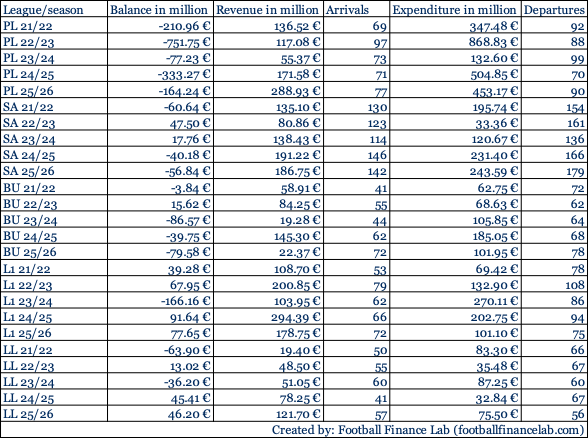
Developments over the last five years reveal some interesting findings. It is particularly noteworthy that Serie A has had the most arrivals and departures in each of the five years. While this figure remains constant, the balance fluctuates noticeably between positive and negative (between -60 and 45 million euros). In general, however, it can be said that the numbers of arrivals and departures over the last five years have not fluctuated greatly among the leagues. Ligue 1 achieved the best balance, with a positive balance in every season except 2023/24. The Premier League, on the other hand, has achieved a negative balance every year. The 2022/23 season is particularly striking here, with a balance of -751.75 million euros. This can be explained by the takeover of Chelsea FC by the Blue Group (led by Todd Boehly) at that time. At that time, Boehly’s investor group alone invested 329.5 million euros in new signings.
Surprisingly, La Liga has achieved a positive balance in three out of five seasons. This can be explained by the strict squad cost rule, which forces clubs in Spain to regularly sell players in order to register new ones. This article provides a detailed explanation of how the squad cost limit works. This theory is also supported by the fact that La Liga has sold 316 players and signed only 263 new players in the last 5 years. Ligue 1 and the Bundesliga have similar ratios and live up to their reputation as selling leagues. Basically, it can be concluded that clear patterns can be identified within the last five years, which only deviate in exceptional cases. These include the Premier League spending the most money, Serie A making the most transfers and Ligue 1 achieving a positive balance.
Global comparison: How non‑european leagues spent during the winter window
Finally, let’s take a look at other leagues and see how much money they spend during the winter transfer window. The top five leagues occupy five of the eight highest positions in terms of spending during this period. The Premier League is in first place, Serie A in second and the Brazilian Campeonato Brasileiro Série A in third, with spending of €201 million. However, it should not be forgotten that in Brazil, the league season follows the calendar year and the European winter transfer window is treated like a summer transfer window in Brazil. The Brazilian top flight achieved a balance of -€16.48 million. The spending ranking is followed by two other leagues that are not among the top five. The MLS follows in fourth place and the Saudi Pro League in fifth. While the MLS also treats the winter transfer window as a summer transfer window, this is not the case for the Saudi Pro League. In terms of balance, the MLS and the Saudi Pro League both recorded losses of just over €90 million. As this period is considered the main transfer window in the USA and Brazil, these countries also have significantly higher figures in terms of arrivals and departures. The Campeonato Brasileiro Série A recorded a total of 574 (262 arrivals, 312 departures) and the MLS 488 (187 arrivals, 301 departures) transfer movements.
In conclusion, it can be said that spending in the winter transfer market once again shows how far ahead the Premier League is of all other football leagues. All other top 5 leagues are only active to a lesser extent in the transfer market and often even make a profit, while the Premier League is the big spender every year, pumping huge amounts of money into the market. These revenues enable clubs from other leagues to regularly generate a transfer surplus or finance their own new signings.


Pingback: European Transfer Market 2025/26: Premier League Dominance