

This article contains affiliate links. If you purchase through these links, Football Finance Lab may earn a commission at no additional cost to you.
The Bundesliga is known worldwide for its fantastic fans, choreographed displays and packed stadiums. All of this is organised and supported by active fan groups. The 50+1 rule also ensures that clubs remain in the hands of their members, who have a say in the clubs’ key decisions. In this article, we analyse how many members the current Bundesliga clubs have, how much membership costs and how much the clubs earn from membership fees. This is particularly relevant for the Bundesliga, as in the top European leagues this is implemented alongside co-determination rights for members and protection against the clubs being sold off to external investors, ensuring that fans are able, for example, to elect their club presidents independently.
How Bundesliga Club Membership Works: 50+1 Rule, Structures and Member Influence
In principle, the members are supporting members of the parent association. This means that the members are members of the registered association, which, under the 50+1 rule, must hold at least 50% plus one additional vote in the limited company. This means that at meetings and when decisions are taken, the members always hold the deciding majority over all other shareholders. This means that members play an essential role in the decisions and direction of the respective clubs and have a say in relevant decisions. They elect the presidents of the parent clubs and elect the supervisory board, which then selects the executive board responsible for operational decisions (how other clubs organize themselves with Multi Club Ownership, for example the Right to dream academy, we have analyzed in this article). You can see how many members the current Bundesliga clubs have in the following overview.
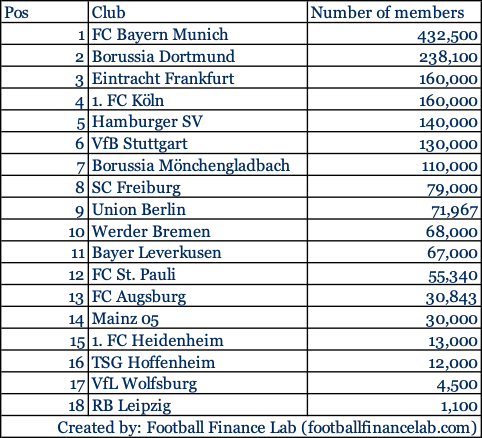
The figures in this table are based on data provided by the clubs themselves, which was published between November 2025 and March 2026. As clubs are not required to publish this information collectively, the figures are based on their own reports and do not have a standard reference date; for this reason, we have taken the most recent publications from the specified period. This does not represent a significant distortion, as membership numbers (barring rapid, exceptional sporting successes) do not change significantly over short periods of time.
But now to the figures, where FC Bayern Munich (as is usually the case) dominates the Bundesliga. With 432,500 members, the German record champions have almost twice as many members as Borussia Dortmund, who sit in second place with 238,100 members. For a long time, Schalke 04 held second place in terms of club membership, but they have since been overtaken by their local rivals and, due to their current status in the second division, do not even feature in the list with their 210,000 members. How FC Schalke 04 uses its members with the help of a cooperative can be found in this recently published article. There is a significant gap between the top two clubs – which also lead the way in most financial indicators – and third place. Third place is shared by Eintracht Frankfurt and 1. FC Köln, each with 160,000 members. At Eintracht Frankfurt, membership numbers have risen rapidly since the 2018 DFB Cup victory and the 2022 UEFA Europa League triumph (originally 57,000 members in 2018). Hamburger SV follows the other two clubs in fifth place with 140,000 members, which is a particularly impressive figure given that, whilst the club has a long history, it had to spend seven years in the second division before returning to the Bundesliga this season. The leading group of traditional clubs is rounded off by VfB Stuttgart (130,000 members) and Borussia Mönchengladbach (110,000 members). The major traditional clubs stand out very clearly from the rest of the Bundesliga sides. One exception, however, stands out in particular. Although Werder Bremen is third in the all-time Bundesliga table, in terms of membership numbers the club is only in 10th place, far behind the other long-standing Bundesliga clubs.
Even SC Freiburg and Union Berlin, with 79,000 and 72,000 members respectively, rank ahead of Werder Bremen. However, these clubs still lag far behind the leading group and represent the top tier of the mid-table clubs. This group is rounded off by Bayer Leverkusen (67,000 members) and FC St. Pauli (55,340 members). Next come Mainz 05 and FC Augsburg, each with around 30,000 members, and together with 1. FC Heidenheim (13,000 members), they make up the smaller clubs in terms of membership numbers. Behind them come only the so-called ‘plastic clubs’, although Bayer 04 Leverkusen ranks higher in the mid-table due to its extreme sporting success in recent years and thus falls outside this group. The bottom three places are occupied by TSG Hoffenheim with 12,000, VfL Wolfsburg with 4,500 and RB Leipzig with 1,100 members. VfL Wolfsburg and RB Leipzig in particular benefit from an exemption to the 50+1 rule, which means that members have no say in the running of the club. Furthermore, these three clubs do not come close to matching the number of fans, the appeal or the tradition of the many other clubs with significantly higher membership figures.
If you want to understand why German football has become a global model for fan culture, club governance and sustainable success, The Bundesliga Blueprint: How Germany Became the Home of Football offers a clear, engaging deep dive into the league’s unique structure and philosophy. It’s an excellent companion to this analysis of membership numbers, fees and the 50+1 system.
Membership Fee Comparison: What Bundesliga Fans Pay in 2026
However, members not only bring democratic participation to the clubs, but also a significant amount of money through their membership fees. In the table below, you will find the annual membership fees for Bundesliga clubs. Here, we have used the standard adult rate, as each club offers countless other options, ranging from discounts for students or senior citizens to gold memberships. To make it easier to compare prices, we have limited ourselves to the standard rate.
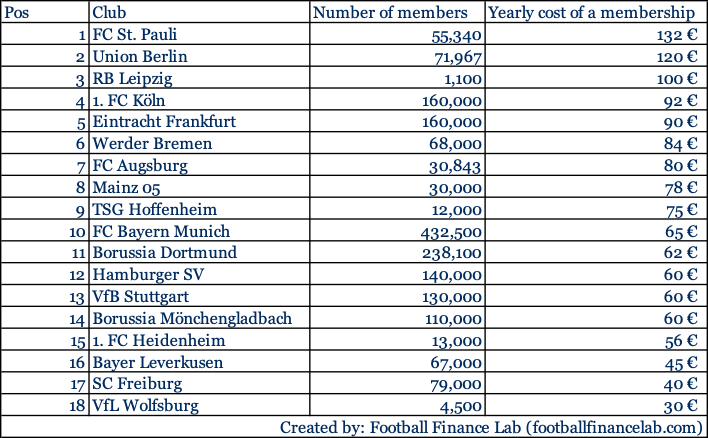
FC St. Pauli has the most expensive membership, with an annual fee of €132. The amount is deducted monthly, which works out at €11 per month. Most Bundesliga clubs, however, collect membership fees annually per season. St. Pauli is followed by Union Berlin at €120 and RB Leipzig at €100. RB Leipzig is also one of the few clubs to offer different membership tiers. Bronze membership (standard) costs €100, Silver €500 and Gold membership €1,000. With the more expensive memberships, members enjoy additional benefits such as priority ticket sales for top matches, or, in the case of the Gold membership, even the chance to meet team or staff members. 1. FC Köln and Eintracht Frankfurt follow in 4th and 5th place with annual membership fees of €92 and €90 respectively. Both clubs also offer a lifetime membership, for example. The fees for these are based on the clubs’ founding years and cost €1,948 and €1,899 respectively. Four further clubs follow with similar prices, led by Werder Bremen at €84. The group is rounded off by FC Augsburg at €80, Mainz 05 at €78 and TSG Hoffenheim at €75. The next group of clubs, which have similar fees, is the largest overall. This is followed by six clubs, led by Bayern Munich at €65 and ranging down to 1. FC Heidenheim at €56. The remaining four clubs – Borussia Dortmund, Hamburger SV, Borussia Mönchengladbach and VfB Stuttgart – are all traditional clubs and have annual membership fees of €62 or €60. In the bottom three places are Bayer Leverkusen at €45, SC Freiburg at €40 and VfL Wolfsburg bringing up the rear at €30. On average, membership of a Bundesliga club costs €74. Exactly half of the clubs exceed this figure, whilst the other half fall below it. This suggests that many clubs operate at a similar level and that there is no dominant leading group. The median stands at €70.
Revenue From Membership Fees: Which Bundesliga Clubs Earn the Most?
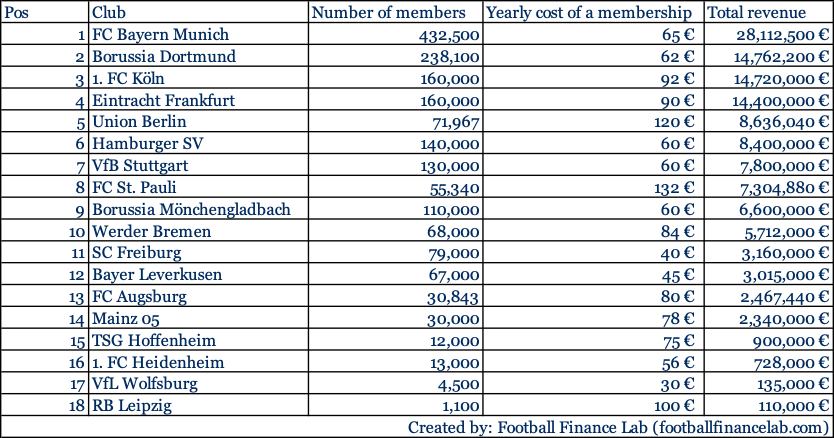
Having already analysed the raw membership figures and the annual membership fees, we will now combine these two figures to calculate how much revenue the clubs generate from membership fees. To simplify this, we will use the figure for standard members, as we did when analysing the fees. FC Bayern once again takes first place by a wide margin (here you will find an analysis of the equity of the Bundesliga clubs, in which the Munich team is also in first place). Although it has only the tenth-highest membership fee, it also has so many more members than the other clubs that they cannot come close to matching it. With €28.1 million, its revenue here is almost double that of second-placed Borussia Dortmund, which stands at €14.7 million. Although both clubs have similar membership fees, Bayern Munich has almost twice as many members. In third and fourth place, 1. FC Köln and Eintracht Frankfurt follow closely behind BVB with 14.7 and 14.4 million euros respectively. Both have the same number of members, but membership with Köln costs €2 more per year. There is a significant gap between Eintracht and Union Berlin in fifth place. The club from the capital comes next with around 8.6 million euros. Behind the Berliners is HSV with 8.4 million euros. Although the Hamburg club has almost twice as many members, Union’s membership fee is also twice as high. VfB Stuttgart comes next with €7.8 million; whilst it charges the same membership fee, it has 10,000 fewer members. Next come FC St. Pauli and Borussia Mönchengladbach in a similar situation to Union Berlin and Hamburger SV. Although Borussia Mönchengladbach has exactly twice as many members, St. Pauli charges more than double the membership fee, meaning the Kiezkickers are ahead with 7.3 million euros, ahead of Borussia with 6.6 million euros. SV Werder Bremen follows with 5.7 million euros.
SC Freiburg are some way behind Bremen, mainly because they have the second-lowest membership fees. Freiburg generate €3.1 million from membership fees. Bayer Leverkusen have similar figures to SC Freiburg and follow with €3 million. The group is rounded off by FC Augsburg and Mainz 05 with €2.4 million and €2.3 million respectively. Both also have similar figures in both areas. TSG Hoffenheim and 1. FC Heidenheim follow with €900,000 and €728,000. Bringing up the rear are VfL Wolfsburg and RB Leipzig. VfL Wolfsburg has the lowest membership fees and, at the same time, the second-lowest number of members. Although RB Leipzig has the third-highest membership fees, they cannot climb above last place due to their extremely low membership numbers. The following table lists the revenue from membership fees.