
This article contains affiliate links. If you purchase through these links, Football Finance Lab may earn a commission at no additional cost to you.
It is June 6, 2015, 10:42 PM Neymar Jr. pushes the ball past Gianluigi Buffon. It is the decision for FC Barcelona, which wins its second treble after 2009 and thus sits on the throne of Europe. Financially, Barca also looks very solid and the club is in a great position on the pitch and next to it. Ten years later, the club has €2.27 billion in debt and has had years in between when it was far from winning the Champions League and was eliminated in the group stage. In this article, we analyze how this came about, what Lionel Messi has to do with the high debt, and take a look at how the development could continue.
How Lionel Messi’s Record Contract Triggered Barcelona’s Exploding Wage Bill and Rising Debt
First, we’ll jump back into the 2014/15 season, which is a real success for Barca and ends with the treble. Financially, the season is also a real success. Barca increases its sales from 530 million in the previous season to 608 million euros. At the same time, although costs also rose from 472 million to 581 million euros, FC Barcelona achieved an operating profit of 49 million euros. One season later, the figures still look good and Barca is achieving sales growth of 71 million euros (+12% to 679 million euros). Expenditure also rose to EUR 630 million, of which EUR 435 million (69% of total turnover) was spent on salaries of players and staff. Gross debt stood at EUR 406 million, which is a gross debt ratio of 0.59. All in all, the club is doing very well economically. In the 2016/17 season, sales again increased slightly to 708 million euros and expenses also continued to rise to 677 million euros. But here, for the first time, gross debt also rises to 493 million euros. FC Barcelona writes in its balance sheet that this increase in debt largely results from the purchase of the Can Rigalt building land, which cost 53 million euros. This was because Barca sold these properties in 2005, but became embroiled in litigation and was ordered by arbitration to repurchase the properties in 2016.
Until this season, the club is on very solid economic footing and in 2017 extended the contract with its superstar Lionel Messi until 2021. With this contract extension, Barca manages to keep its figurehead at the club, but pays a high price for it. Because the entire salary structure of Barca is being blown up. Messi will earn a total of 555 million euros in the four years up to 2021, which corresponds to an annual salary of approximately 139 million euros. This can be seen in the extreme change in spending on players and staff. This was €432 million in 2016/17 and will skyrocket by a whopping €207 million (a 48% increase) to €639 million within a year. Although sales also rise sharply to 914 million euros, the new high expenditure can only be financed with external donors. This means that the club has a gross debt of 1.02 billion euros for the 2018/19 season. Barca has thus almost tripled its gross debt in two years and stands at a gross debt ratio of 1.02, almost doubling it. This shows how FC Barcelona has become heavily indebted within a very short period of time due to rising spending on players’ salaries.
If you want to dive deeper into the history of the club the book Barça: The rise and fall of the club that built modern football offers you beautiful insides.
COVID‑19’s Financial Shock: Revenue Collapse and the Debt Spiral at FC Barcelona
This development comes at the worst possible time, because in the midst of the cost spiral, the Corona pandemic is collapsing across the world and is causing the Catalans to lose not only sharply rising costs but also important revenues. For the first time, sales fell from 954 million euros in the previous season to 818 million euros, resulting in a further 136 million euros missing from the coffers. At the same time, gross debt continues to rise to EUR 1.17 billion. Due to the lack of ticket revenue and a long break from playing, the club lacks important income to continue paying the high player salaries, which amounted to 636 million euros. This means that although these have fallen slightly (probably due to a lack of point and casserole premiums), they still accounted for 74% of total sales. In its balance sheets, Barca states that a corridor of 60%-70% is the target corridor to be profitable in operations. This corridor will be crossed for the first time in many years in the 2019/20 season, which shows that FC Barcelona is in a downward spiral at this point.
Corona restrictions will continue in the following season. In March 2021, a new president, Joan Laporta, was elected, who, after a long period of silence, had to deliver bad news to Barca fans at the end of the season. Barcelona doesn’t have enough money to renew their contract with their superstar Lionel Messi, let alone register it in La Liga with the Squad Cost Regulations, even if he were to play for a symbolic euro. In the following article you will find the current squad cost figures as well as a detailed explanation of these La Liga rules. This season, the percentage share of salaries for players and employees reaches a new peak with 98% of total turnover, showing the club’s major economic problems at that time. Barca’s turnover falls to 631 million euros, while salary expenditure falls to only 617 million euros. The club is achieving a catastrophic and worrying result with an operational loss of 505 million euros. While gross debt falls slightly to €1.15 billion, the disastrous operating result has an impact on Barca’s equity. This is a negative amount of -451 million euros. This leaves the club virtually insolvent and urgently needs fresh money to survive. In addition, the sharp decline in sales increased the gross debt ratio to 1.82.
For readers who want to understand how football clubs really make — and lose — money, The Price of Football is one of the clearest and most practical introductions to modern football finance. It explains revenue models, wage structures, amortisation, debt, and the financial decisions that shape clubs like FC Barcelona.
The Camp Nou Reconstruction: How the €1.5 Billion Project Reshaped Barcelona’s Financial Future
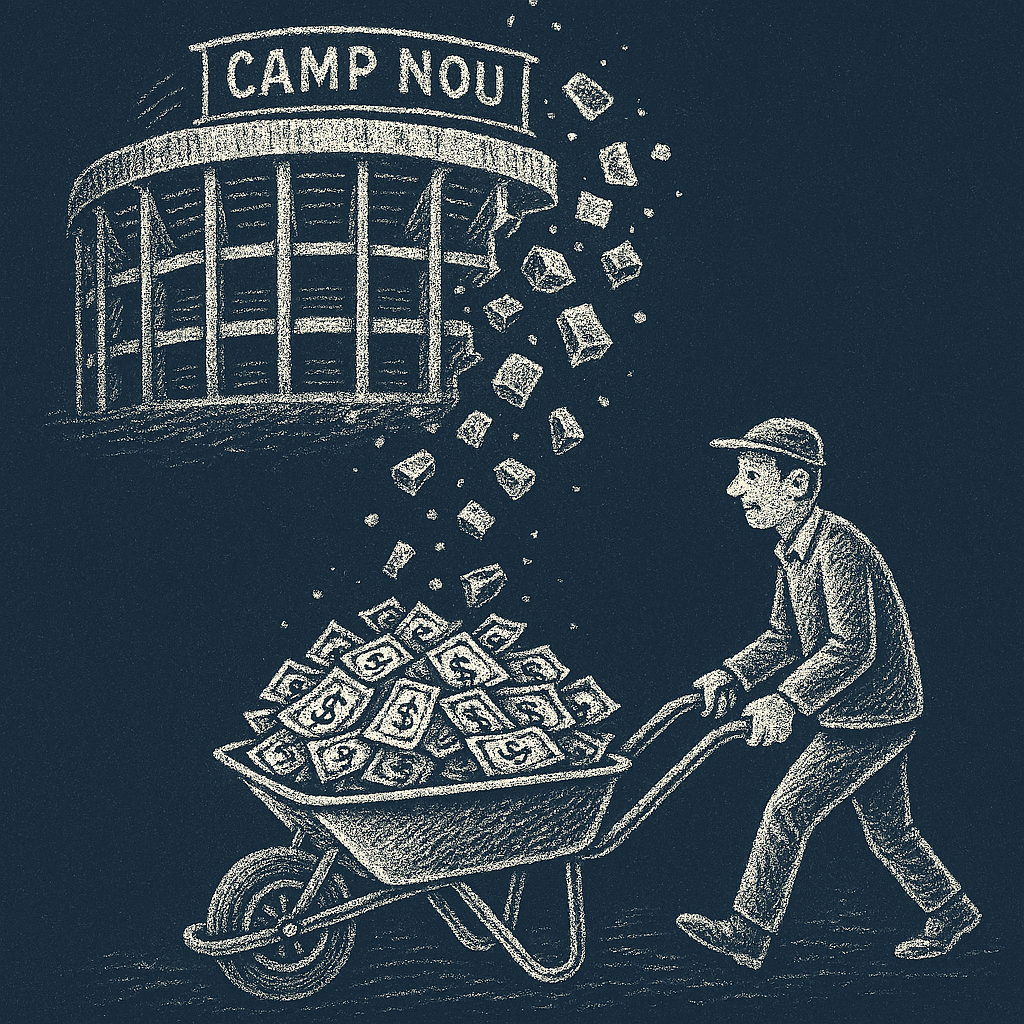
One season later, in the midst of the economic crisis, Barca announced that it would completely renovate and modernize the Camp Nou for a total of 1.5 billion euros. The plan calls for the modernization to be completed by 2025. The Corona pandemic will come to a final end in 2022 and stadiums will be full again, giving FC Barcelona hope of seeing sharply increasing sales again. This will already be achieved in the 2021/22 season with an increase of 61% to 1.02 billion euros. Among other things, Barca is selling future revenue from TV rights this season, for which the club will receive 344 million euros. This is urgently needed in order to remain solvent. In addition, total expenditure falls by 25% to EUR 856 million, which means that Catalans can achieve an operating profit of EUR 161 million. However, gross debt continues to rise to a total of EUR 1.52 billion, with equity rising to EUR -353 million. A detailed analysis of the equity of all German Bundesliga clubs can be found here. An improvement and a start in the restructuring of the club’s finances, although at this point the club remained in a precarious situation. The following 2022/23 season is expected to be Barca’s last at the Camp Nou, which the club will once again use to improve its finances. Turnover rises again by a further 24% to EUR 1.26 billion. This is due to further divestments of TV rights and other image rights, which will bring the club a further 443 million euros. In addition, the club generates 229 million euros from revenue at Camp Nou, which represents an improvement of approximately 100 million euros. At the same time, however, the association’s expenses also increase by 36% to 1.16 billion euros. Among other things, expenditure on player and employee salaries rose to 676 million euros (an increase of 30% or 158 million euros). Gross debt can be sharply reduced to EUR 1.15 billion at the same time. In addition, the Espai Barca project, which is financed by a secured fund, is founded. Espai Barca is to be used to secure the modernization of Camp Nous.
The modernization of Camp Nous now ensures that the club’s debt continues to rise. On the one hand, this is due to the fact that the club is missing out on important stadium revenue, as it has to temporarily play in the much smaller Estadi Olimpic Lluis, which has only a few VIP areas. On the other hand, debt is increasing as FC Barcelona is largely financing the modernization through debt. This also shows the further increase in gross debt from 2022/23 to 1.3 billion euros in the following season. In this, Barca only has a turnover of 866 million euros, but can continue to increase its equity to -94 million euros, even though the club suffers a total loss of 91 million euros in the financial year. FC Barcelona’s latest financial report shows further increased debt. We recently took a close look at the entire balance sheet in the following article. In the 2024/25 season, gross debt will therefore be 1.9 billion euros, which represents a gross debt ratio of 1.91.
Future Outlook: Can Barcelona Recover From Its Record Debt Burden?
The further development of Barca’s finances is difficult to predict, but there are some positive signals. The club has almost completed the modernization of Camp Nous and is expected to be able to play every game at its home ground at full capacity in the 2026/27 season. This ensures that the club will generate significant additional revenue in the future. He urgently needs this because of the heavy debt burden. It will take a few years and also financial discipline for Barca to pay off its debts and become a financially healthy club. To do this, FC Barcelona urgently needs to learn from its past mistakes. This definitely does not include the modernization of Camp Nous, which was urgently needed and will enable the club to generate extremely high new revenue opportunities in the future. However, this includes player salaries that are too high, especially when viewed as a whole with the club’s turnover. Barca is already limited by La Liga’s Squad Cost Limit. This does ensure that the club is somewhat slowed down in its current development. But it will also ensure that the club will recover financially in the long term. Overall, it can be said that FC Barcelona has overcome the low point and is developing financially in the right direction.