

This article contains affiliate links. If you purchase through these links, Football Finance Lab may earn a commission at no additional cost to you.
The MLS Players’ Union publishes the salaries of all MLS players each season, making the MLS one of the only leagues to reliably publish its players’ salaries. In this article, we explain which numbers are published, who earns the most, and which teams spend the most on their players despite valid salary caps.
MLS Salary Structure Explained: Base Salary vs. Guaranteed Compensation
Basically, the MLS, with its structures and a system borrowed from US sports, offers drafts, trades, and a salary cap (we have already provided a detailed explanation of these rules in this article). This also means that the players do not conclude contracts with the clubs, but with the league. This is one of the reasons why salaries are public. The salaries indicated are given in two different forms. Once the base salary, which indicates the base salary for the season. The Annual Guranted Salary, in turn, indicates what a player is guaranteed to earn for the season. Guaranteed signature bonuses or, in general, all guaranteed bonuses are included. This means that if, for example, a player signs a four-year contract with $500,000 as a base salary and a signature bonus of $400,000, the Annual Guaranteed Salary per year is $600,000 (signature bonus is split between each individual year. Bonuses and player agent costs are also priced into the Annual Guaranteed Salary Marketing. Flexible bonuses linked to sporting parameters are not included and can be paid out additionally.
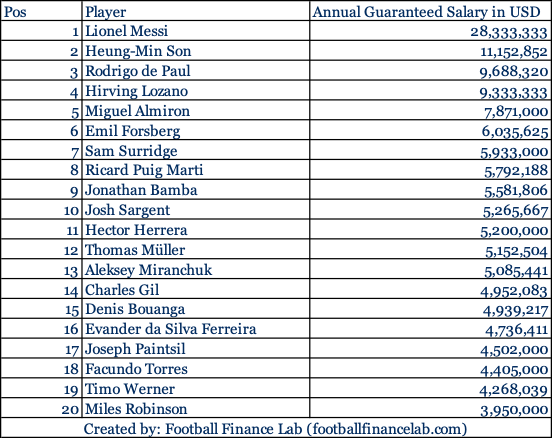
The top earner is (how could it be otherwise) superstar Lionel Messi. He earns $25 million as a base salary and €28.3 million as Guranted Compensation, which is by far the highest salary in both categories. In order to better compare salaries and include all payments to players, we compare guaranteed compensation in the following article. In second place comes Heung-Min Son, another internationally known star with $11.1 million, which is not even half of Messi’s salary. Messi and Son are also the only players in the MLS to earn tens of millions. Third place goes to Rodrigo de Paul, an Argentine world champion and Messi’s teammate both on the national team and in Miami. He earns $9.7 million. It’s also exciting that there isn’t a single American player in the entire top 10. The highest-ranked US player is Miles Robinson, ranked 20th with a salary of $3.95 million. For most players, the order of base salary and guaranteed compensation is essentially the same. Only Hirving Lozano stands out here. He ranks fifth with his base salary but fourth in guaranteed compensation, closely behind Rodrigo de Paul with $9.3 million. The following chart shows the 20 highest salaries of all MLS players.
If you want to understand how Major League Soccer grew into a global powerhouse — from the Apple TV deal to the arrival of Lionel Messi — The Rise of Major League Soccer: Building a Global Giant is one of the most insightful books available. It breaks down the league’s business model, strategic expansion, and the forces shaping MLS ahead of the 2026 World Cup.
Average MLS Salaries by Position and Highest Earners
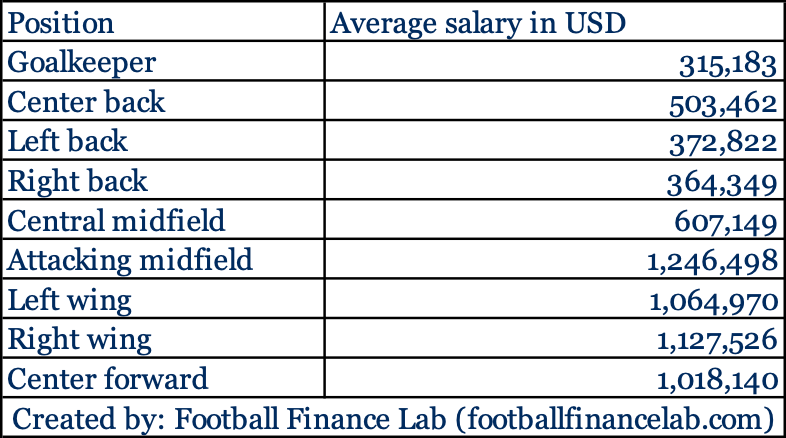
The average salary of an MLS player is $695,795 for the 2026 season. A player who does not fall under the Designated Player Rule may earn a maximum of $803,125 per season as a senior player on his base salary (may be higher on the Annual Guaranteed Salary). We have explained the exact rules for the MLS Salary Cap and Designated Player rules in the following article. The breakdown of average salaries per position is also exciting. The average salary of a goalkeeper is the lowest, at only $315,183. Swiss player Roman Bürki leads all goalkeepers with a salary of $2.75 million. Full-backs are at a similar level. A left-back earns an average of $372,822, slightly more than a right-back earns $364,349. Sergio Regouilon is the highest-paid full-back with just $1.8 million. Center-backs, on the other hand, manage as much as $503,462, with Miles Robinson being the highest-earning center-back with $3.95 million. He appears in 20th place out of all player salaries. The central defenders are followed by the central midfielders. These earn on average $607,149. However, the average salary is particularly boosted by a few less well-paid players, led by Rodrigo de Paul. An average striker earns a little more than a million dollars, making them the first position group to earn over a million dollars and also be allowed to earn more than a senior player according to MLS rules. The highest-earning striker is Sam Surridge at $5.9 million. The wingers, which include right and left midfielders, earn an average of $1.06 million on the left and $1.13 million. Although Lionel Messi is counted as a right winger, the two winger positions are not the highest paid positions, but these are only surpassed by the attacking midfielders. This is because there are significantly more players there with 19 players who earn over a million dollars. Overall, the average offensive midfielder in the MLS earns $1.25 million. Aleksey Miranchuk earns the most, at $5.08 million. The following overview shows all average salaries per position group in the MLS.
MLS Club Salary Rankings: Total Spending in 2026
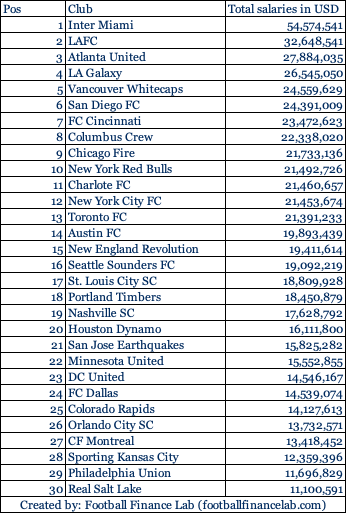
From the published documents, one can not only find out the player salaries, but also how much the MLS clubs each spend on their team. In first place by a wide margin is Inter Miami with $54.6 million. This is hardly surprising, given that two players, Lionel Messi and Rodrigo de Paul, are among the league’s top three earners. Lionel Messi is also by far the top earner. He earns more per season than almost any other MLS club spends on their overall rosters. Only runner-up LAFC spends $32.6 million more than Messi’s salary of over €28 million. In terms of salaries, Inter Miami is in a league of its own, although this is only so strongly influenced by the two Argentinians. Luis Suarez, another former world-class Miami player, earns just $800,000, which is a normal MLS salary for a senior player. A total of eleven other clubs are above average salary expenditure. On average, an MLS spends $20.3 million on its total squad, which is very little compared to the personnel costs of clubs from Europe’s top leagues. In another article, we have already analyzed La Liga’s Squad Cost Limit in more detail, where each club has more salary available than the average MLS club spends (the full analysis can be found here). Atlanta United is in third place with $27.9 million, followed by LA Galaxy in fourth place with $26.5 million. The Vancouver Whitecaps ($24.6 million), San Diego FC ($24.4 million) and FC Cincinnati ($23.5 million) follow at a slight distance in the other places. Also above average salary spending are all clubs with similar salary spending between $21.4 million and $22.3 million: Columbus Crew, Chicago Fire, New York Red Bulls, Charlotte FC, New York City FC, and Toronto FC. The 17 other clubs below average are led by Austin FC with $19.9 million. Close behind are the New England Revolution ($19.4 million), Seattle Sounders ($19.1 million), St. Louis ($18.8 million) and the Portland Timbers ($18.5 million). In the bottom three places are Sporting Kansas City with $12.4 million, Philadelphia Union with $11.7 million, and Real Salt Lake with $11.1 million. It’s also exciting that almost every club covers the MLS’s standard salary cap, which is due to the three designated players (players whose salaries are not included in the salary cap). The following table shows all salary expenses of the respective clubs.