


This article contains affiliate links. If you purchase through these links, Football Finance Lab may earn a commission at no additional cost to you.
Real Madrid is one of the biggest clubs in the world, if not the biggest club in the world. This applies both to sporting success and to the financial strength that Real carries within itself. This is particularly evident in the operational turnover, where the royals rank first among all football clubs worldwide. In this article, we analyze Real Madrid’s financial report from the 2024/25 season and show the success factors and the path to financial football power.
Long‑Term Revenue Growth: How Real Madrid Became a Global Financial Powerhouse
Real Madrid has had a very interesting development over the last 10 years. Overall, the club managed to increase its operating revenue tenfold. This grew from EUR 118 million to EUR 1.185 billion. The distribution of sales shares has also changed. In the 1999/2000 season, revenue from the stadium was the second highest, accounting for 32% of operating revenue. Most football clubs will have been 25 years ago. Nowadays, Real generates the most of its sales with 43% in marketing. This will not be the case with most football clubs these days. Most football clubs generate the majority of their revenue from TV marketing. At Real Madrid, this position is only 14%. Twenty-five years ago, this revenue was 33%, the highest. This is fundamentally an interesting development, albeit a very unusual one. At the beginning of the 2000s, most football clubs generated the majority of their revenue from stadium revenue, which was not the case for Real Madrid even then. The fact that nowadays it is only 14% and Real Madrid generates almost half of its operating turnover in marketing shows what a big and popular brand Real Madrid has become. Real Madrid is a worldwide well-known brand with diverse fans spread all over the world. A characteristic that only the largest clubs in the world can fulfill. Also interesting is the International & Friendly Matches position, where the share of sales has increased from 9% to 14% over the last 25 years. This is due to the increasing commercialization and internationalization in football, which Real Madrid (as a pioneer with Manchester United) is itself fueling. Here, additional revenue is generated through various tours and friendly matches on new potential markets (mostly in Asia or the USA) during the summer break.
As football clubs expand their digital presence, online security becomes more important than ever. Protect your own accounts with NordPass, a secure and easy‑to‑use password manager.
On average, Real Madrid manages to increase its sales by 9.7% per year. This number would have been even higher if the Corona pandemic had not caused empty stadiums and a collapse in revenue for three years. But even during the pandemic, the club showed its strength and managed to increase its sales every year during the three years of the pandemic (after a sharp downturn in the first year). Two other metrics have also changed significantly at Real Madrid in the last 25 years. Of particular interest here are the percentage personnel costs of operational turnover. In the early 2000s, Real Madrid’s figure was very unhealthy. 70% is the maximum percentage a healthy football club should spend on personnel expenses. In the 2000/01 season this figure was 86% and in the following season even 90%. With such values, the club would have experienced financial difficulties in the long run and the Royals managed to reduce this value to 52% in the 2003/04 season. After that, this figure remained at roughly the same level until it only rose again to over 60% during the Corona years, which can be explained by the lower revenues. After the pandemic, the figure was reduced again and was only 43% in the 2024/25 season. The values also directly influence operating profit before depreciation. In the last 25 years, Real Madrid has suffered only two losses, which fall precisely during the period of high personnel expenditure. The largest loss occurred in the 2001/02 season with 45 million euros, which also recorded the highest percentage personnel expenditure. When Real Madrid subsequently reduced salaries and increased sales, the club achieved an operating profit before depreciation every season from 2003/04 onwards. This continued to grow with small interim slowdowns and stood at a whopping 243 million euros in 2024/25. The profit that Real Madrid thus makes operationally is a higher value than most La Liga clubs actually record in terms of turnover. For comparison, Sevilla FC achieved an operating turnover of 155 million euros in the same season, combined with a percentage personnel expenditure of 99% (we have analyzed Sevilla FC’s finances in more detail in the following article).
Revenue Breakdown 2024/25: Marketing Boom, Matchday Strength and TV Decline
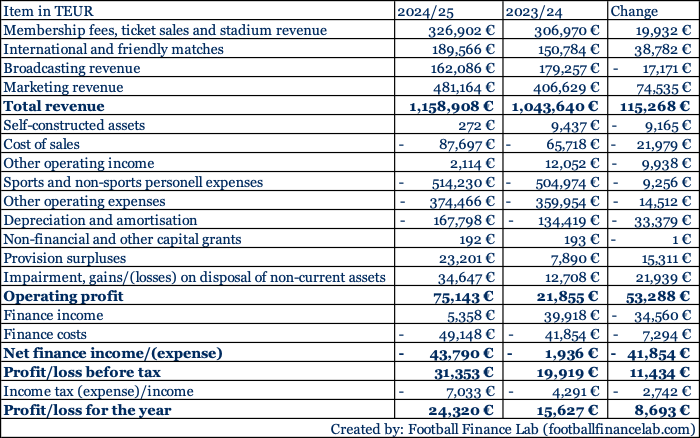
After analyzing the last 25 years of Real Madrid’s financial success, we now analyze the gains and losses of the 2024/25 season. In total, Real has generated revenue of 1.159 billion euros, an increase of 115 million euros and a percentage increase of approximately 11% (revenue in the 2023/24 season was 1.044 billion euros). The largest part is marketing revenue of 481 million euros. This part increased by 18% compared to the previous season from the original 407 million euros. This part is by far the largest share of revenue and will generate 326 million euros in revenue from stadium revenue, ticket sales and revenue from membership fees. This part also increased by approximately 19 million euros compared to the previous season (increase of approximately 5%). The two other parts of turnover are significantly smaller than the first two parts and are roughly at the same level. One of these two parts is revenues from international and friendly matches amounting to 189 million euros. This part also increased by 26%, making it the highest percentage (in the 2023/24 season, sales in this part were still 150 million euros). The last and smallest part on the sales side is TV revenue, which was 162 million euros. This share is also the only part that has decreased in sales compared to the 2023/24 season. TV revenues fell by approximately 9% from EUR 179 million to EUR 162 million. This is presumably due to the lack of success in the Champions League, in which the Royals were eliminated by Arsenal in the quarter-finals, while they managed to win the Champions League the previous season.
If you want to understand the deeper philosophy behind Real Madrid’s long‑term success, this book is an outstanding resource. “The Real Madrid Way” explains how values, culture and strategic management shaped the most successful football club in the world — far beyond money or star players.
On the loss side (as with any football club), the costs for personnel are the highest. For Real Madrid, these were 514 million euros, which corresponds to a small increase of approximately 9 million euros. The second largest item from the expenditure side is very cryptically grouped by Real among other operational expenditure. This part corresponds to expenditure of EUR 371 million. Here, too, there was a slight increase of approximately 9 million euros. These costs can be divided into several sub-areas. The largest of these is External Services, amounting to EUR 244 million. These include costs for ongoing maintenance, royalties, leases, advertising and utilities. Another large part of the expenditure was on depreciation, which amounted to 168 million euros. These increased by EUR 34 million (by 25% from the original EUR 134 million). Another major cost factor is the purchase of raw materials, which amounts to approximately 88 million euros. In total, Real Madrid therefore has an operating profit of 75 million euros. This has therefore also increased dramatically and more than tripled compared to the 2023/24 season (growing by 53 million euros from 22 million euros). In addition to operating profit, there are financing costs (mainly loan interest costs) of EUR 49 million. This is largely due to the financing of the renovation of the Santiago Bernabeus. Thus, Real Madrid generated a profit before taxes of 31 million euros in the 2024/25 season. After deducting 7 million euros in taxes, profit after taxes was 24 million euros, an increase of 9 million euros compared to the previous season. The following presentation shows the entire profit and loss account of the Madrilenians.
Balance Sheet Analysis: Assets, Debt Structure and the Bernabéu Investment
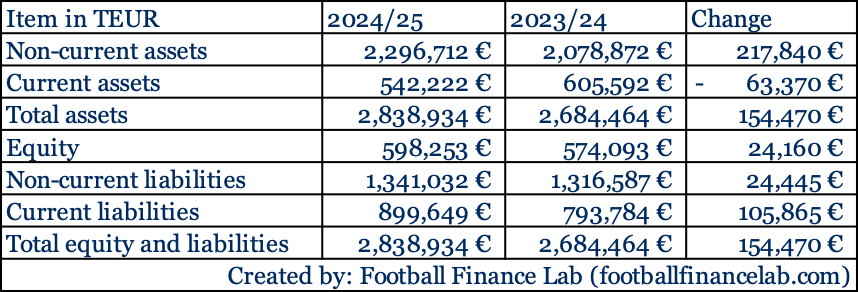
In the consolidated balance sheet, Real Madrid has a total balance sheet total of EUR 2.84 billion. This represents the highest balance sheet total of a football club in the 2024/25 season. This is an increase of approximately 160 million euros from a balance sheet total of 2.68 billion euros in the previous season. The balance sheet total is divided into assets and equity/liabilities. The assets are divided into short-term and long-term assets. In short-term assets, Real Madrid has 542 million euros, which represents a slight downturn compared to 606 million euros last year. These short-term assets consist largely of two positions. The largest position is receivables from trade with 344 million euros. Surprisingly, these are not mostly short-term demands on other clubs from player transfers. This is mainly unpaid income from stadium and marketing revenues (together approximately 149 million euros). There are only 48 million euros in claims for player transfers from other clubs. Also interesting are the demands on state-owned equipment, which Real Madrid has for a total of 77 million euros. The second major position in short-term assets is cash of EUR 176 million. The long-term assets of the royals total 2.29 billion euros. These were increased by 210 million euros compared to the 2023/24 season. By far the largest share of this is tangible assets amounting to 1.56 billion euros. This largely includes the modernization of the Santiago Bernabeus as well as the stadium itself. The second large part in long-term assets are intangible assets in the sports sector. This refers to the book values of players who are in the squad. These amounted to 499 million euros in the 2024/25 season and were increased by 50 million euros. We have explained in more detail how values are reported and written off in a balance sheet of football clubs in the following article using Juventus as an example.
The same consolidated balance sheet total is typically achieved for equity and liabilities. This consists of equity capital of EUR 598 million. Equity, at EUR 594 million, consists almost entirely of capital and reserves. The reserves amount to 512 million euros. The liabilities are again divided into short-term and long-term liabilities. Current liabilities are significantly higher than long-term liabilities and amounted to 1.34 billion euros in the 2024/25 season. With 1.23 billion euros in long-term loans and bonds, these are predominantly represented in one position. These loans and bonds can also be attributed to financing the modernization of the stadium. It is also interesting to see that Real Madrid does not have high liabilities for transfer fees. These are only EUR 15 million for long-term liabilities (EUR 76 million in the short term). Current liabilities were approximately EUR 900 million. These consist largely of three different parts. The largest share is accounts payable of EUR 430 million. These are also divided into three major parts. Payments to sports staff are the highest in this regard, amounting to EUR 208 million. One might think from these pure numbers that Real Madrid owes its players and staff large salary payments. In the Royals’ balance sheet, this is reflected in planned success-related bonus payments and special payments made in July and December. This means that payments not made for possible successes to players and employees have already been included in the balance sheet. The second large part of short-term liabilities are short-term loans and bonds amounting to EUR 329 million. The last large part of short-term liabilities are provisions, which amount to 104 million euros. This is almost all revenue from season tickets, membership fees and marketing revenue, which was already collected in the 2024/25 season but will not appear until the following season. The consolidated balance sheet can be seen in the following overview.
Conclusion: Why Real Madrid Remains Financially Strong Despite Massive Stadium Debt
Overall, it can be stated that Real Madrid is suffering a heavy burden of debt due to the modernization of the Bernabeus. This is also the case with the second major Spanish giant, FC Barcelona, whose record we have analyzed in the following article. The big difference between Barca and Real is currently stadium revenue. Since Barca has not yet been able to play in the fully functional Camp Nou in the 2024/25 season, the Catalans generated significantly less ticket revenue (especially for hospitality and VIP tickets) than the Royals. Real Madrid also addresses a liquidity risk due to the high modernization costs, while Barca does not mention this in its balance sheet. Real Madrid does have a negative result when it comes to comparing liabilities and receivables (the net balance between receivables and liabilities is a key figure that indicates how liquid an association is). However, Real Madrid compensates for this with two cash inflows. Once a year, Real Madrid reliably achieves high operating profits (also a difference from FC Barcelona). Furthermore, the Royals have guarantees for high credit lines, which could compensate for operating profits in the event of a default. In summary, despite high debts, Real Madrid is doing well financially thanks to its good operational business and is therefore financing the modernization of the stadium, which, when modernized, is expected to lead to even higher revenues.


Pingback: Real Madrid’s 2025/26 Finances Hit Historic Record Levels