
This article contains affiliate links. If you purchase through these links, Football Finance Lab may earn a commission at no additional cost to you.
Arthur Blank is a name that most football fans won’t say anything about, yet he plays a bigger role in the football business than most would think. Arthur Blank is a co-founder of Home Depot and has made a large private fortune through it, which has even made him a billionaire. Blank recognized quite early on how much economic potential there was with the ownership of sports clubs in the USA. That’s why he bought the Atlanta Falcons from the NFL in 2002 and was able to expand his wealth as well. In this article, we explain how Arthur Blank built his Multi Club Ownership construct with his AMB Sports and Entertainment (AMBSE), which clubs belong to it, the specifics of his MCO, and how his clubs connect across different sports.
Atlanta United: Rapid Rise, Expansion Strategy, and Stadium Power
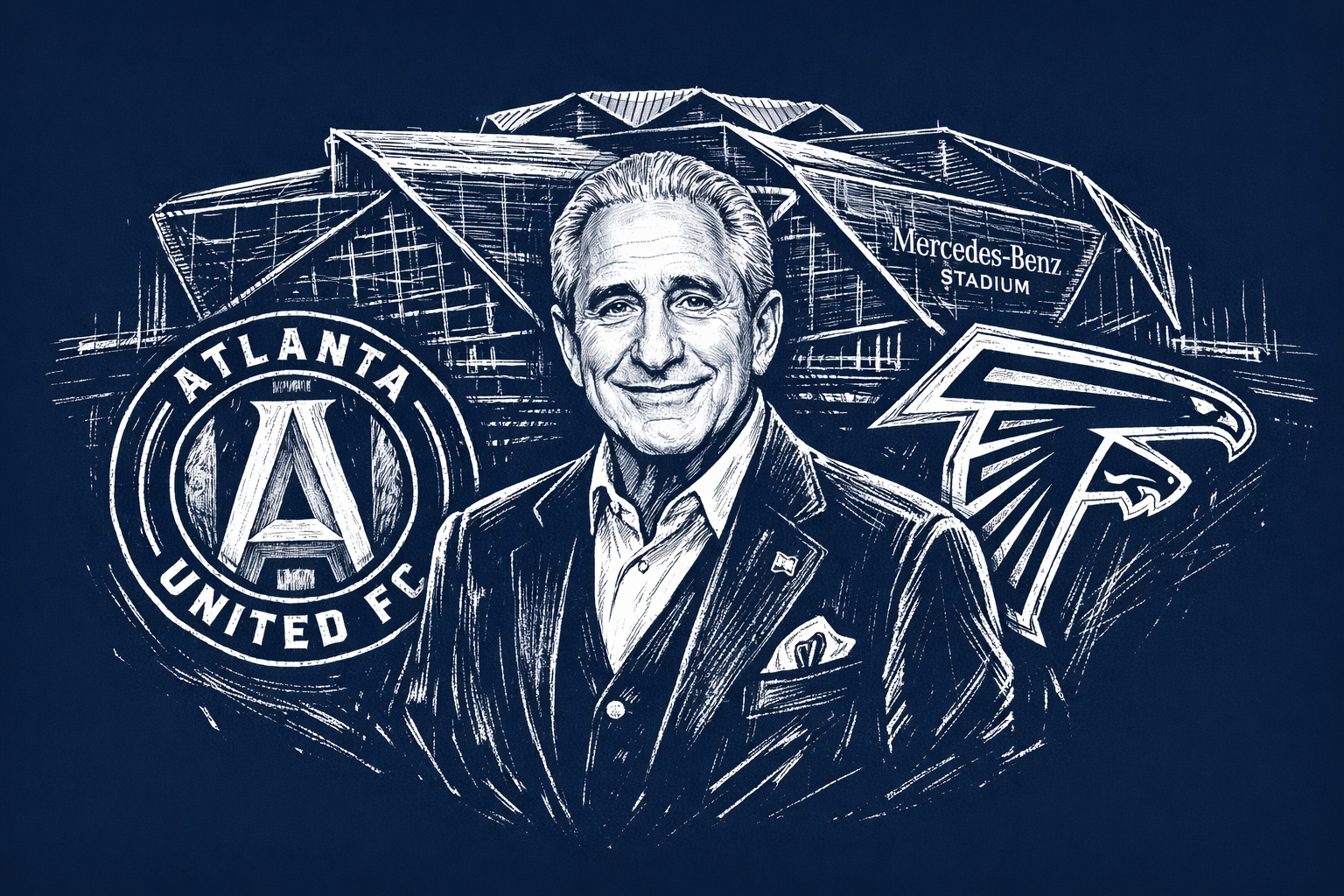
Atlanta United is a very young club. The club was only founded in 2014 and admitted to the MLS in 2017. That means the club only played 9 seasons in professional football. With such a young club, you would think that the club only has a small stadium and not many fans come to the games. But at Atlanta United it’s completely different. Here Arthur Blank directly uses his existing connections. Atlanta United shares Mercedes-Benz Stadium, which is the stadium of the Atlanta Falcons and can accommodate 73,000 spectators. In its inaugural 2016 – 17 season, Atlanta United averaged 48,200 spectators and sold out 9 of 17 games. This shows how the club was directly embraced by the people of the Atlanta area and how Arthur Blank is building his Multi Club Ownership construct. He does this with a different strategy than most MCO’s. His way to do this is through cheap prices at the Games. Seats start at just $30, and food prices at matches are also extremely fair. Ticket prices at the World Cup in the USA, however, are significantly higher, and an analysis of this can be found in the following article. This then increases the number of spectators and people’s enthusiasm/acceptance for the club again. Another way to support the club was to establish a modern training center in Atalanta for use by the club and the U.S. national team. Arthur Blank contributed $50 million to the construction.
If you want to dive deeper into the rise of Atlanta United and understand how the club built its identity, Atlanta United FC: A Legacy in Motion is a great companion. The book explores the team’s journey, cultural impact, and the passion that shaped one of MLS’s most successful expansion clubs.
It is generally interesting to see that the AMBSE is not limited to one sport. This is unusual for multi-club ownership constructs in football, but common in the US sports market. In the US, most owners are billionaires and often invest in different sports within a region to create synergy effects between sports clubs. This is also due to the fact that in US sports there is a leading league with fixed teams without promotion or relegation. This guarantees a permanent place in a league, but it requires fewer synergy effects. Most MCOs use these effects between their teams, which play in different countries and leagues and usually play in leagues of different strengths. From a sporting perspective, Atalanta United does not use any other club. Although AMBSE holds a 10% stake in Aberdeen FC of the Scottish Premier League, there are no increased transfers between the two clubs. The reason for joining Aberdeen FC is said to be a partnership between the two clubs at the level of scouting and operational work. This means that both clubs benefit from the other club’s new knowledge regarding the two fields mentioned. AMBSE’s only other sports club is the Atlanta Falcons. AMBSE thus runs a Multi Club Ownership across several sports.
How AMBSE Leverages Multi‑Sport Synergies to Build a Unique Ownership Model
Arthur Blank uses this special feature bidirectionally. This means that both clubs benefit from each other. This is also not the case with every multi-club ownership construct. Often, Multi Club Ownerships are built in a pyramid scheme, with several clubs at different levels working towards a club at the top. For example, this is also the case in the Right to Dream network, which we analyzed in the following article. The focus here is on the stadium. This was rebuilt in 2017 and helped Atlanta United directly use a stadium that is modern and has a high capacity. The Falcons benefit from the fact that the stadium was built in the first place through multiple use and subsidized by the City of Atlanta. The stadium construction also focused on the 2026 FIFA World Cup. In this one, most of the games are actually played at the Mercedes-Benz Stadium. This also has a positive impact on Atlanta United and could increase the average attendance. Both clubs also benefit from each other among their fans. Blank can sell tickets in bundles or promote each other at the teams’ respective home games. Atlanta United also benefits from existing structures and expertise in marketing or merchandising for the Falcons. This is where the club can easily pick up. Overall, AMBSE is looking to further expand sporting events in Atlanta and would like to field another team in the NWSL women’s soccer league in the future. Here, Arthur Blank’s approach is to build a construct across multiple sports in one location with different clubs.