

How Player Amortisation Works in Football Club Accounting
When a player changes clubs, the receiving club usually pays a transfer fee to terminate the player’s contract with their current club and acquire the rights to the player. The player then signs a new contract with their new club. Depending on the agreement between the clubs, a transfer fee is paid for the player, which is either paid in full immediately or spread out in instalments over several years. It is common practice that if a club buys a player out via a release clause in their contract, the full amount is paid immediately. In the case of transfers with freely negotiated transfer fees, however, payments are in most cases spread over several years. The transfer payments themselves then appear on the profit and loss account of both clubs. Revenue from transfer sales is recognised on the income side upon payment, whilst the expenditure is recognised as a loss by the acquiring club. This means, for example, that if FC Barcelona, due to high levels of debt (an analysis of Barça’s current financial situation can be found here), sells a player to Juventus for €50 million and the clubs agree that this sum will be paid off in equal instalments over five years, Barça’s profit and loss account will show €10 million in revenue in the year of the sale, whilst Juventus will record €10 million in expenditure. However, in Juventus’ balance sheet, the player is listed under assets at his full value of €50 million, despite the club having spent only €10 million on him. In FC Barcelona’s balance sheet, the player and his value disappear from the assets. At first glance, this sounds like a pretty good deal for quickly improving a club’s balance sheet in the short term. This is because, despite only €10 million having been paid, the full value is immediately recognised as an asset. To prevent this from being used as a constant, misleading way of dressing up the balance sheet, player values are gradually written down. This means that whilst the player’s value is initially treated as an asset following his signing, it is simultaneously written off over the years. The depreciation period is generally based on the length of the player’s contract. However, as Chelsea FC increasingly used this to spread and minimise the burden on its books (the background to this was the Premier League’s PSR rules, which will be replaced by new rules from the 2026/27 season onwards and were analysed in detail in a separate article), the amortisation period was set at a maximum of 5 years. Chelsea had offered players contracts of 7–8 years (for example, Enzo Fernández or Mykhalo Mudryk) in order to artificially keep the amortisation amounts in the respective balance sheets low. Let us return to our example player, who was signed from Juventus for €50 million and received a 5-year contract. These 50 million euros will be recognised as operating expenses in equal instalments of 10 million euros each over the next five financial years and thus written off.Juventus’ 2024/25 Squad Amortisation: Net Book Values and Contract Durations
Having first looked at the depreciation of player values in general, we will now examine the depreciation of Juventus’ players. In total, Juve had players in its first-team squad for the 2024/25 season with a cost of €532 million. In addition, they had players in their reserve team (Next Gen) who cost €7 million, and further players on loan at other clubs, with a historical cost of €117 million. Arthur Melo accounts for by far the largest share of this at €80 million, and will continue to be a liability to the club with a net book value of €13 million until the end of his contract on 30 June 2027 (€67 million has already been written off). In total, Juventus had players on its books last season who originally cost the club €659 million. Of this sum, €335 million has already been written off, with €324 million still outstanding. Of this, €298 million relates to active first-team players. If you want to understand how data, probability and decision‑making shape modern football, The Numbers Game offers a clear, analytical introduction. Teun Koopmeiners tops the list with a net book value of €43 million. He originally cost Juve €52 million, of which only €9 million has been written off to date, and the remaining book value will also be written off by 30 June 2029. Koopmeiners is followed by Douglas Luiz, Nicolas Gonzalez and Bremer. Douglas Luiz cost €49 million when he was signed, of which €14 million has been written off so far, resulting in a remaining net book value of approximately €35 million. Bremer cost €51 million when he was signed, slightly more than his compatriot. €23 million has been written off for Bremer so far, leaving him with a net book value of €28 million. Nicolas Gonzalez was previously signed for €35 million, but only €6 million has been written off, leaving a net book value of €29 million. All three players’ contracts also run until 30 June 2029. Generally speaking, most of Juve’s players’ contracts expire on 30 June 2029. One player whose contract runs only until 30 June 2026 is Dusan Vlahovic. The striker, who was once the fourth most expensive signing in the club’s history, cost €85.4 million when he was signed. To date, approximately €66 million has been written off, leaving a net book value of €19.5 million. This must be written off in full during the current season and will therefore be charged in full to Juventus’s balance sheet for the 2025/26 season. It is also interesting to note that rising star Kenan Yildiz places virtually no burden on Juventus’s balance sheet. This is due to the low transfer fee that the Old Lady paid when she signed the Turkish international. He cost just one million euros when he was signed. Loanee Francisco Conceicao does not weigh on the balance sheet at all, as he did not add any value to Juventus’s books, since, as a loanee, he still belonged to FC Porto. Juve have since signed Conceicao on a permanent basis, which is why he will also appear in the balance sheet for the current season. A table listing all first-team players and their transfer fees, amounts already written off, remaining net book value and contract duration can be found here.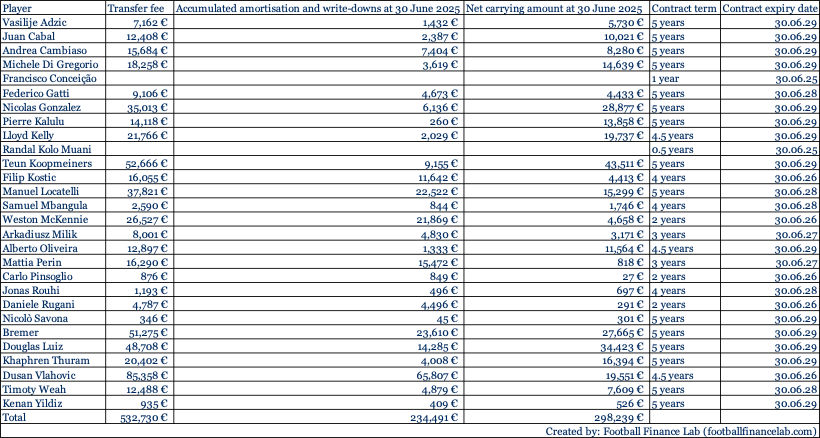
How Player Sales Impact Juventus’ Profit and Loss Statement
It is also interesting to understand what happens to a player’s net book value when he is sold. Let’s take Matias Soule as an example, who was sold to AS Roma for €25.6 million. He was listed with a present value of €23.8 million and had a remaining net book value of just €1.5 million. As a result, Juventus recorded a profit of €22.3 million on its balance sheet. Selling a player can therefore be worthwhile if they have the highest possible current value and, at the same time, the lowest possible remaining net book value. Moise Kean was sold to Fiorentina for €13 million. He had a current value of €12 million and a remaining net book value of €10 million. In accounting terms, Juventus was therefore only able to make a profit of €2 million from the sale. In total, players worth €133 million were sold during the 2024/25 season. These had a net book value of €42 million, enabling Juventus to make a profit of €90 million. With depreciation of €117 million, this results in a loss of €27 million in this category.
If you enjoy analysing player values, contracts and transfer strategies, Football Manager offers one of the most detailed football economics simulations available.
Juventus’ Outstanding Transfer Receivables and Payables Explained
Whilst the net book values are weighing on Juventus’ balance sheet, there are two further key figures reported in the accounts that also have an impact. These are the outstanding receivables and payables to other clubs relating to transfer payments. Juventus has outstanding receivables amounting to €105 million. This can be broken down into current (€48 million) and non-current (€57 million) amounts. Of this, €93 million (€38 million current, €55 million non-current) relates to Italian clubs and €20 million (€15 million current, €5 million non-current) to international clubs. A total of €8 million is deducted due to adjustments for underlying financial income. Among the Italian clubs, Fiorentina, along with city rivals Lazio and AS Roma, are at the top of the list. Fiorentina still owes Juve €25 million, whilst AS Roma owes €21 million and Lazio €20 million. Among the international clubs, Aston Villa, AFC Bournemouth and Cruzeiro lead the way. Here, the sums are significantly lower, with the Villans and Bournemouth each owing €5 million and Cruzeiro €4 million.
However, Juventus is not only set to receive income from past transfers, but also still has to pay money to other clubs. In total, Juventus has liabilities of €224 million to other clubs. This is split into €115 million in short-term liabilities and €114 million in long-term liabilities. €123 million (€58 million short-term, €65 million long-term) of the liabilities are owed to Italian clubs, whilst €109 million (€62 million short-term, €47 million long-term) is owed to international clubs. A total of 8 million euros is deducted due to adjustments for underlying financial income. Among the Italian clubs, Atalanta and Fiorentina lead the list of liabilities, followed by AC Milan. Atalanta is due to receive a further 39 million euros, Fiorentina 26 million euros and AC Milan 15 million euros from Juventus in the future. Among the international teams, two English clubs – Aston Villa and Newcastle United – are again at the top, followed by OGC Nice. Aston Villa is claiming the most here at €37 million, whilst Newcastle will receive significantly less at €14 million and Nice at €13 million. If you want to dive deeper into the European transfer market you can find an analysis of the last winter transfer window here.


Pingback: Manchester United Financial Report 2024/25 Explained