

This article contains affiliate links. If you purchase through these links, Football Finance Lab may earn a commission at no additional cost to you.
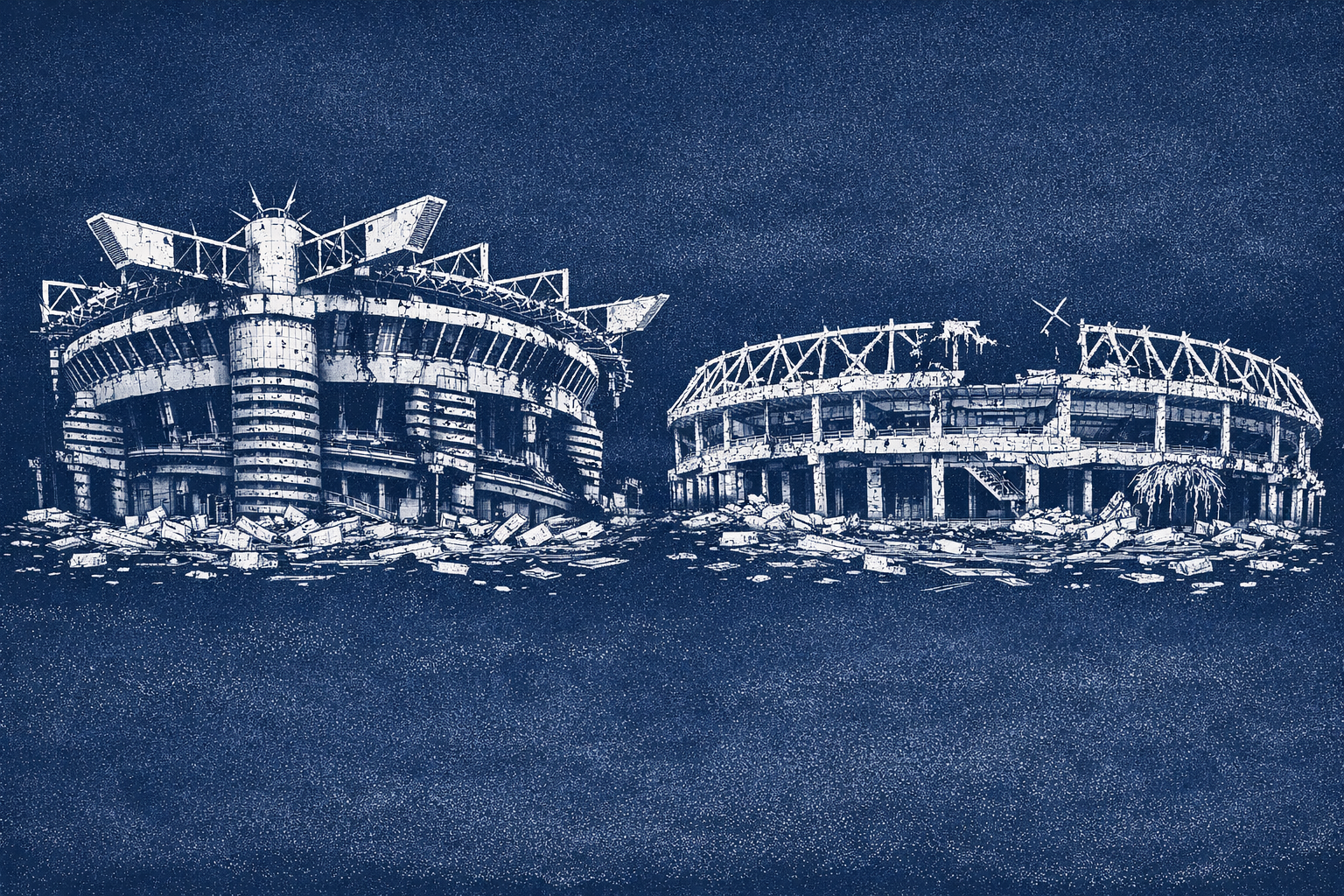
The European Championship will take place in Turkey and Italy in 2032. But recently UEFA had serious doubts about the condition of stadiums in Italy. Most stadiums in Italy are very old and sometimes dilapidated. For the tournament, many clubs plan to build or modernize their stadium. However, there are always major delays in permits or construction itself in Italy. Thus, very few Serie A teams have a modern stadium. In this article, we analyze the reasons why Italian clubs are lagging behind in modernizing their stadiums and look at the impact that the lack of modernization has had.
Bureaucratic Roadblocks: Why Stadium Approvals in Italy Take Years
As early as 2020, many clubs complained that although they wanted to rebuild or modernize their stadiums, this entailed extreme bureaucratic hurdles. The big problem here is a law that applies to the protection of buildings of architectural importance. This is a recurring problem, as some of the stadiums are so old that they are listed as historical monuments. This is because most of the stadiums were last modernized for the 1990 World Cup, but were not rebuilt and are therefore very old. Lazio and AS Roma, Fiorentina, and Milan’s two city rivals AC and Inter faced particular problems. The Monument Protection Act ensured that these clubs were not allowed to demolish the old stadium and build a new one on the same site. At the same time, it was difficult to find another location for a new stadium.
In the meantime, after many years of proceedings, an agreement has been reached with the respective building authority of the city for all of the above-mentioned clubs. AC and Inter Milan bought the stadium site for 197 million euros and are building the new stadium on it. A new stadium is to be built there by 2035, which will be in operation as early as 2031 and will continue to be used jointly by both clubs. However, it was not possible to rebuild San Siro because the monument protection laws continue to block this. The situation is similar for both Roman clubs, although they will not be able to get a new stadium together. AS Roma will be allowed to build a new stadium, but it is not yet clear what will happen to Lazio Rome. Lazio could be able to remain in the Olympic Stadium or be allowed to build a new stadium as well. Fiorentina was the best to solve it and is already renewing its existing stadium without having to move. An alternative financing for work on the stadium can be the cooperative, which we analyzed in another article using Schalke 04 and FC St. Pauli as examples.
For readers fascinated by football architecture and the unique character of stadiums around the world, Remarkable Football Grounds offers a stunning visual journey. It highlights how design, location and cultural heritage shape the matchday experience — a perfect complement to understanding why modern stadium development matters so much today.
Construction Chaos: Delays, Cost Overruns and Legal Disputes Across Serie A
But the construction of new stadiums, which can finally be built or modernized after the lengthy approval process, is also causing extreme problems for the clubs. The modernized Artemio Franchi Stadium was originally scheduled to be completed in 2026. However, a number of problems arise during construction, which mean that it is now even questionable whether the stadium will even be built as planned. Since the city is largely responsible for financing the modernization, it also has construction management. Fiorentina criticizes the fact that it is not sufficiently involved in the planning and implementation of the construction. Construction is being delayed further and further, which also poses further problems for Fiorentina. During construction, parts of the stadium have to be closed again and again, which temporarily reduces the revenue per matchday. Fiorentina also co-finances the stadium with its own share. However, a total of 50-60 million euros is currently missing in financing (if there is further interest in the finances of Italian clubs, there is an article on Juventus’ balance sheet here). The reduced revenues in the current phase then make this additional financing difficult for the club to manage. Overall, it is currently still questionable whether the stadium will be finished and in operation by the 2032 European Championship.
While in Florence it seems to be an organizational and financial problem in modernization, in Rome there are other problems. Here again there are problems with the authorities and legal requirements. While obtaining approval for a new stadium or upgrade is generally a difficult, lengthy process, permits during construction can also delay it. In the event of the construction of AS Roma’s new stadium, there will be a delay due to the approval for the felling of 26 trees on the stadium grounds. Since, according to the Regional Court in Rome, the case would cause damage to nature, the case was not allowed for the time being. On May 13, 2026, the regional court will issue a further decision on what will happen to the trees and whether they can be felled. This will also lead to further delays in the new stadium construction in Rome.
Lost Revenue and Rising Costs: How Outdated Stadiums Hurt Italian Clubs Financially
The current stadium situation has many different financial implications for Italian clubs. What is particularly serious is that in most stadiums there are no opportunities to sell hospitality or VIP tickets. This ensures that the clubs have significantly less revenue than other clubs from the top 5 leagues, even though they have the same capacity. This is because they have little chance of selling high-priced tickets and ensures that the prices of standard tickets are increased to counteract this a little. This is problematic for the clubs and fans, as the club receives less matchday revenue and fans have few affordable tickets available. Construction itself represents a further financial burden. This must be partially financed by the clubs and can lead to major financial burdens, such as FC Barcelona, which has already been analyzed in more detail in the following article. But not only does the financing itself cost the clubs a lot of money, but the transition period can also ensure that matchday revenues continue to decline due to reduced capacity. This creates a difficult financial situation in which revenues fall and expenditures rise sharply due to high investments and loan payments. However, it can still be stated that it is necessary for clubs to make these investments in stadiums in order to increase revenue in the long term and remain competitive.
Pingback: World Cup 2026 Ticket Prices: Full Cost Breakdown