
This article contains affiliate links. If you purchase through these links, Football Finance Lab may earn a commission at no additional cost to you.
Eagle Football Holding has repeatedly caused a stir in European football as one of the most well-known but also most controversial multi-club ownerships. This was due to new approaches to player recruitment, the attempt to circumvent the French tax authority or the financial problems of Olympique Lyon that accompanied the takeover of Eagle Football Holding. In this article, we explain which clubs belong to Eagle Football Holding, what strategy it uses, and what consequences this has for the clubs and also for multi-club ownership.
Takeover of Lyon, Botafogo, Molenbeek & Crystal Palace
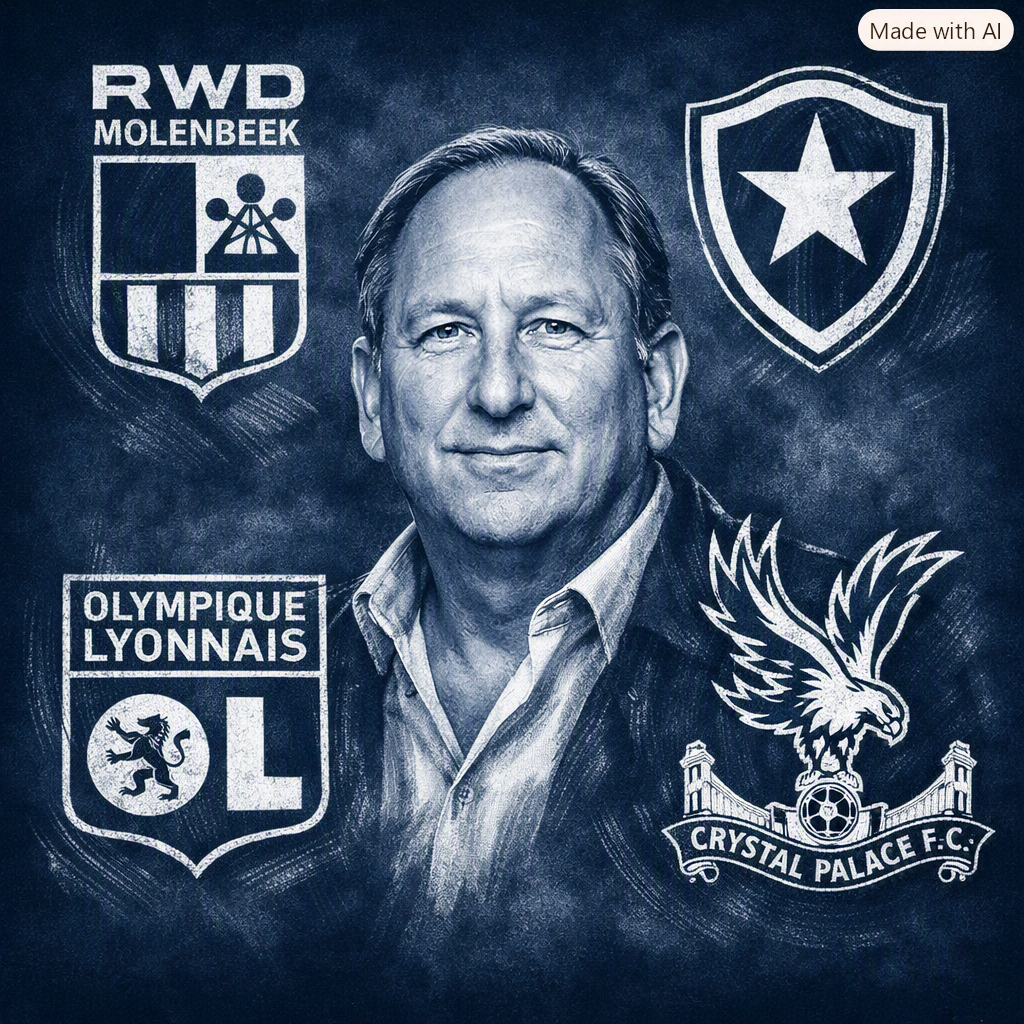
Eagle Football Holding will launch in 2021 with the acquisition of 40% of Crystal Palace’s shares. This allows John Textor, CEO and owner of EFH, to directly enter the football business at a Premier League club. This entry is made possible at Crystal Palace, as they already had other US investors, including Steve Parish, Josh Harris, and David Blitzer. Blitzer is a well-known investor in sports clubs and also owns the New Jersey Devils (NHL) and the Philadelphia 76ers (NBA), among others. Just a few months after joining Crystal Palace, Eagle Football Holding also joins RWD Molenbeek and acquires 80% of the shares. This means that EFH still holds the additional share in all shares. A month later, Botafogo from Brazil joins them. Eagle Football Holding holds a majority stake here with 90%. Until November 2022, these properties were all managed directly under John Textor and not yet by Eagle Football Holding, which Textor then founded and has since managed the shares in the respective clubs. In December 2022, Eagle Football Holding will acquire 78% of Olympique Lyonnais. A few months later, EFH increases its stake in Crystal Palace to 46%. Overall, a construct of different clubs from different countries was built in a very short time, a classic Multi Club Ownership (a more detailed explanation can be found here). Meanwhile, control of Eagle Football Holding is no longer held by John Textor, and Crystal Palace and Olympique Lyonnais are also no longer owned by him. We will discuss both circumstances in more detail later in this article.
If you want to understand the global rise of multi‑club ownership, the business logic behind football portfolios, and how groups like City Football Group or Red Bull built their networks, this book offers one of the clearest and most structured analyses available. Multi‑Club Ownership in Football: Strategy, Power, and the Future of the Global Game breaks down the financial systems, ownership rules, UEFA regulations and the impact on fans and competitive integrity.
John Textor’s Ownership Strategy and Player Development Model
John Textor is building his Multi Club Ownership largely with majority shares in order to have complete control over the clubs. In contrast to David Blitzer, he focuses exclusively on football. Arthur Blank is also a major sports investor in the USA, which we have examined in more detail with his investments in the Atlanta Falcons and Atlanta United. However, unlike Blank, Textor does not want to create local synergies, but rather develop players for its largest clubs through a sophisticated system. All clubs in the chain should benefit. This model is used time and again in Multi Club Ownerships and is one of the main reasons why investors in football do this. The advantage is that players can be loaned out and trained in-house and then eventually play for the best club in the MCO in the target image. This is also important in today’s recruitment of young players, for whom such constructs can show a precise career plan. Normal clubs without an MCO usually cannot do this to this extent.
It is precisely such a system that John Textor relies directly on. He makes particularly heavy use of Botafogo for this purpose. On the one hand, he invests heavily in the club and improves the squad enormously. This brings the club sporting success with victory in the Copa Libertadores and the Brazilian championship in 2024. On the other hand, he sends an extremely large number of players away from Botafogo and transfers them to either Molenbeek or Lyonnais. At Crystal Palace, its sphere of influence is limited by minority participation, which is why they are not involved in the many transfers. In the first full season after taking over Botafogo, these transfer nine players to Molenbeek and one to Olympique Lyonnais. The following season, there will be seven players back for RWDM and two for OL. Since Molenbeek doesn’t operate at the same sporting level as Botafogo, they will benefit particularly from the many new players. The players also benefit from Molenbeek with a lot of match practice. After the first season with the support of Botafogo’s players, Molenbeek was promoted directly to the Belgian first division, but this success did not last long. After one season in the Jupiler Pro League, RWDM was immediately relegated and has not been promoted again since.
RWD Molenbeek also plays a major role in another story that made international headlines. In the 2023/24 season, Molenbeek bought Ernest Nuamah from FC Nordsjaelland for 25 million euros. This remains the record transfer in Belgian football to date. Nuamah previously attended the Right to Dream Academy, which is another MCO with its own special features and focus on African football. We analyzed Right to Dream in more detail in the following article. But Nuamah is not scheduled to play for Molenbeek and will not play a single game for RWDM to date. The reason for the transfer is Olympique Lyonnais’ problems with the French tax authorities, which means that OL cannot sign Nuamah. Eagle Football Holding circumvents these restrictions by signing the player to Molenbeek and lending him directly to Lyonnais. In summer 2024, Olympique will sign the player permanently for 28.5 million euros. What remains, from Eagle Football Holding’s perspective, are three winners. Lyonnais were able to sign the player despite severe restrictions imposed by the DNCG, Molenbeek generated a transfer profit of €3.5 million without any effort, and Nuamah was able to move to his preferred club, OL. This example shows exactly how Eagle Football Holding uses its Multi Club Ownership System to gain advantages over traditional clubs.
Football fans today manage multiple accounts – streaming platforms, ticket portals, club apps and fantasy football services. NordPass helps you store all passwords securely and access them across devices without risk.
Financial Crisis at Olympique Lyon and the Fall of John Textor
The reason John Textor and Eagle Football Holding had to use such a trick was due to the financial problems Olympique Lyon had at the time. The club, like many other Ligue 1 clubs (a detailed analysis can be found here), was hit hard by the default of TV money payments. In addition, OL has experienced major financial burdens due to the construction of the new Groupama Stadium. This culminated in debts of 500 million euros, which the club had at the end of 2024. This prompted the DNCG to impose a transfer freeze on OL and order them to urgently reduce debt by summer 2025. Olympique Lyonnais failed to achieve this and was forced relegated to Ligue 2. With great effort, OL narrowly prevented this by depositing 200 million euros into its own account. However, this sum was not secured by John Textor, but by two other actors. An investment fund called Ares provided one half (also acts as a lender to John Textor and his Eagle Football Holding). The other half was taken over by Michele Kang (who had previously acted as the majority owner of OL’s women’s team), who subsequently led to John Textor’s resignation and took over the club’s management in the summer of 2025 after massive fan protests against Textor. A year later, Olympique Lyonnais faced another crossroads as financial problems continued. After negotiations with the insolvency administrator OL’s, Michele Kang took over 88% of the club on June 26, 2026. John Textor and Eagle Football Holding are therefore no longer owners of Olympique Lyonnais. Thus, Eagle Football Holding lost its second club after Crystal Palace, which we will now discuss.
UEFA Conflicts: Lyon & Crystal Palace and the Multi‑Club Ownership Rule
After the founding of Eagle Football Holding, Crystal Palace was already Textor’s club with the least sphere of influence. This was because the Eagles were the only club in the MCO with only a minority stake. However, this minority participation caused massive problems when Olympique Lyonnais and Crystal Palace qualified for the Europa League in the 2024/25 season. In order to maintain sporting integrity, UEFA prohibits the participation of several clubs that have the same owner in a significant form. In practice, it amounts to the owners of several clubs having the opportunity to place their shares in a trust account and leave them there until March 31st before the new season. This was the case, for example, with Manchester City and Girona FC (both part of the City Group) participating in the Champions League in the 2024/25 season. However, since Eagle Football Holding did not do this in time, Crystal Palace had to take part in the Conference League (due to their worse league position, having qualified by winning the English Cup). This again caused harsh fan protests against Textor by Eagles fans. As a result, Eagle Football Holding sold its shares to Woody Johnson, which, however, also prevented Crystal Palace from being allowed to participate in the Europa League.
Little by little, John Textor ran into financial difficulties with Eagle Football Holding. This meant that in 2026 he lost control of Eagle Football Holding, which is now owned by creditors (mostly Ares). However, this has not led John Textor to reconsider his investments or shy away from new football investments. He showed in a documentary about the 50+1 rule (a detailed explanation of the rule can be found here) that he was a fan of Eintracht Frankfurt and could imagine investing in this club if the rule in question did not exist. John Textor, with his Eagle Football Holding, is an example of how investments in football can end in disaster for the respective clubs, which also applies to the integration of a club into a multi-club ownership. On the other hand, clubs with financial problems cling to such investors in order to save the club and hope for new opportunities, as was the case with Botafogo.