
This article contains affiliate links. If you purchase through these links, Football Finance Lab may earn a commission at no additional cost to you.
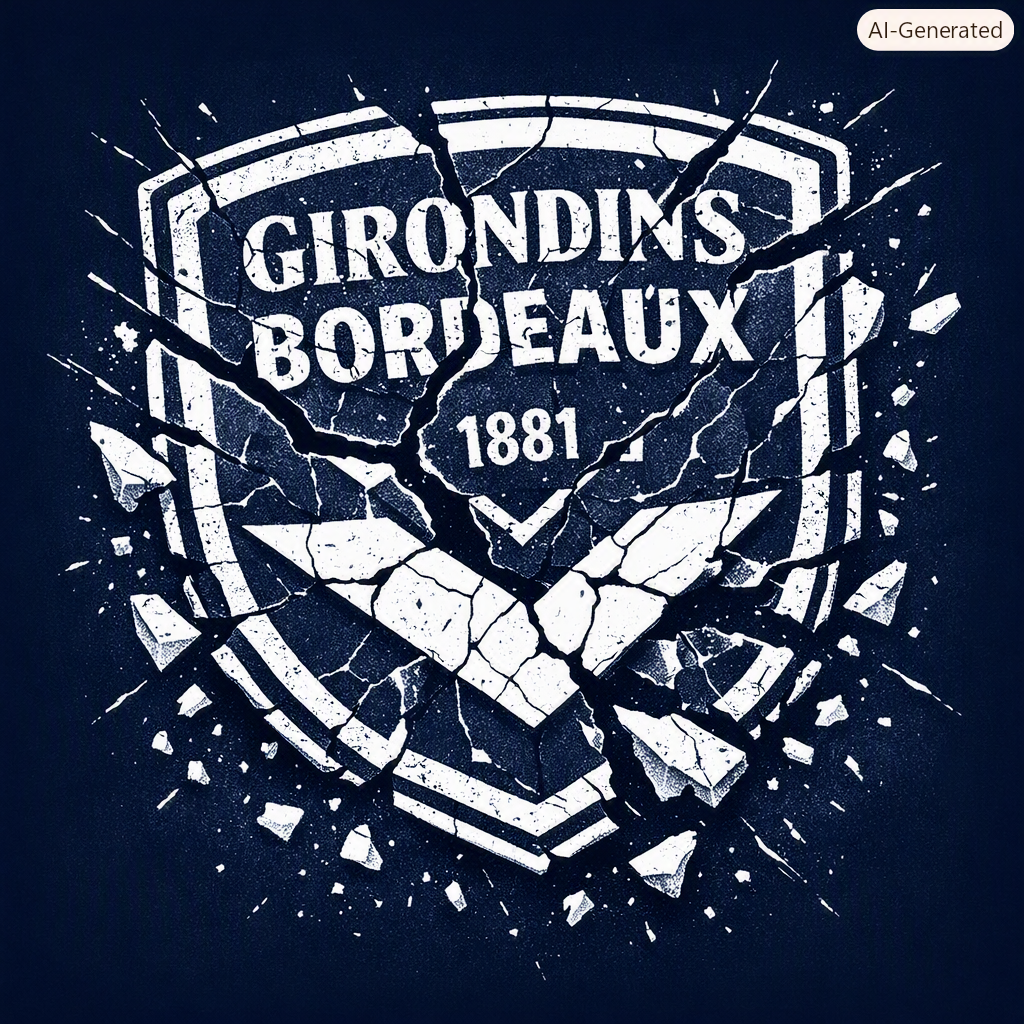
It’s official that Girondins Bordeaux will be relegated again due to punishment by the French tax authority, the DNCG. This time, however, they’ll be relegated to the sixth division and thus out of professional or semi-professional football. In this article, we show how the club went from being a top French club to an amateur club, the financial disasters and background behind it. We also examine how forced relegation could have occurred again and what will happen next with Bordeaux.
Rise of Girondins Bordeaux: From Domestic Dominance to European Success
Let’s start first with the successful time of Girondins Bordeaux. This begins in modern football in the 1980s. There, the majority of the association is taken over by Claude Bez, who also takes over the office of president. From the acquisition of Bez, Bordeaux starts spending big money. Claude Bez wanted to make Girondins Bordeaux a top French team, relying primarily on top French players. Bez brought players like Jean Tigana, Thierry Thusseau, and Gernot Rohr to Bordeaux, among others. Bordeaux already had a few star players, such as Alain Giresse. Through the mix of existing good players and other star players, Girondins Bordeaux managed to win three French championships and two French Cups. Bordeaux was also successful internationally, reaching the semifinals of the European Cup (the predecessor of the Champions League) and the European Cup Winners’ Cup. However, after its rise to prominence in the 1980s, the first minor crisis arose. In 1991, Bordeaux was forced to be relegated due to administrative reasons.
The forced relegation forced Bordeaux to increasingly rely on its own youth players, which, in retrospect, was an absolute stroke of luck for the club. In 1992, one season after the forced relegation, the club was immediately promoted again. Young players helped, some of whom would later become absolute football legends. The team was peppered with players such as Zinedine Zidane, Bixente Lizarazu and later Sylvan Wiltord. So the club managed to become a top team in France again at the end of the 1990s. This resulted, among other things, in a UEFA Cup final loss to Bayern Munich and another league title in the 1998/99 season. This was also the moment the club acquired new owners, the M6 Group (French media group). Following the change of ownership, further successful years followed, during which the club repeatedly played in the Champions League and won two more titles: the 2008/09 French Championship and the 2012/13 French Cup. The club was an established Ligue 1 force.
The Financial Downfall: Mismanagement, Ownership Turmoil and Forced Relegations
Girondins Bordeaux’s decline begins in 2018 with another change of ownership. M6 sold its shares in the club for 70 million euros to Joseph DaGrosa, who was the chairman of General American Capital Partners and president of the club and already held 13.6% of all shares in Bordeaux. A year later, this group sold its shares (which had become a large part through the acquisition of the M6 shares) to a new owner, King Street Capital. After the takeover of King Street Capital, the Corona pandemic broke out, resulting in the club having less revenue. At the same time, Mediapro, which was responsible for the TV revenues of all Ligue 1 clubs, went bankrupt, which led to all Ligue 1 clubs experiencing significant losses in scheduled TV marketing payments (a detailed analysis of the impact on Ligue 1 to date can be found here). These two circumstances meant that King Street Capital did not want to make any further investments in the club. Due to these three factors, the club suffered extremely financially, which was also evident on the pitch. Girondins Bordeaux finished last in Ligue 1 in the 2021/22 season and was relegated to the second division again after 1990/91. However, this time the consequences were significantly more severe. Due to the club’s existing financial problems, the DNCG wanted to relegate it even further to the third division. However, Bordeaux resisted this and was able to avert it before the sports court. In the second division season, everything looked as if they could regain their former glory, but Girondins narrowly missed promotion to Ligue 1, finishing third. A season later, the financial problems continued to persist. The DNCG ordered a forced relegation to the third division. The DNCG ordered a forced relegation to the third division. The club could no longer avert this and, due to insolvency, it was hit even harder, so that it even had to be relegated to the fourth division.
The final insolvency resulted primarily from the takeover of Gerard Lopez. The Luxembourgish-Spanish businessman took over the club in 2021. In addition, he also bought shares in Boavista Porto and Royal Mouscron to create a Multi Club Ownership construct. A detailed explanation of how Multi Club Ownership works can be found in this article. Under his ownership, all three clubs were relegated from the first division and slipped into insolvency. This is no coincidence. Gerard Lopez is known for buying shares in clubs and then investing little to nothing. The problem is that the shares in football clubs are usually sold to investors because the clubs have financial problems or need external capital to continue to be solvent. If Lopez then takes over a club in large part or even completely but does not invest, it is only a matter of time before the club slides into insolvency.
If you want to understand how football clubs really operate behind the scenes — from balance sheets to ownership models and financial collapse — The Price of Football by Kieran Maguire is one of the most insightful books available. It explains exactly the mechanisms that led clubs like Bordeaux into crisis.
Bordeaux’s Latest Collapse and What the Future Holds for the Club
After relegation and insolvency were sealed, Girondins Bordeaux started playing in the French fourth division with Andy Caroll as striker and the ambition to return to professional football as quickly as possible. Leicester City also suffered an unprecedented relegation, which we have already analyzed in the following article. This could not be achieved and the club continues to suffer from financial difficulties. This now resulted in the next forced relegation to the sixth division and another insolvency. This resulted from another acquisition by Sparta Capital. Sparta Capital wanted to buy 67% of all shares of Gerard Lopez and pledged to invest 10 million euros initially to pay off the 9 million euro debt and save the club from renewed insolvency. The sale of the shares was approved by the DNCG, but Sparta Capital was unable to pay the 10 million euros, which led to the forced relegation.
What happens next with the club is anyone’s guess. The club has lost massive value in recent years, having to give up its status as a professional team and sell its youth performance center (the former heart of the club) when it was first forced to be relegated. This, along with the enormous debt, will deter many investors. Most importantly, the club will consolidate, which can also be achieved with the help of the municipality. The fans remain loyal to the club, which is the average attendance of approximately 10,000 spectators per game in the fourth division. The municipality also supports the association, as it is the main user of the Stade Atlantique, newly built in 2015. This is a large bargaining chip for the club and could continue to support the club in the future. The club relies on the support of the municipality and possibly the entry of former players to get back into professional football as quickly as possible. The club will quite likely succeed in doing this as they continue to have the support of the fans.