
This article contains affiliate links. If you purchase through these links, Football Finance Lab may earn a commission at no additional cost to you.
The Bundesliga is one of the largest football leagues in the world, which is followed by many people every year. In this article, we analyze how TV money is distributed in the Bundesliga and which club receives how much.
How Bundesliga TV Money Is Distributed
In total, the German Football League (responsible for the operation and marketing of the first and second Bundesliga) will receive 1.121 billion euros per season for the 2025/26 to 2028/29 seasons. This is even an increase of approximately two percent compared to the last rights period (out of an original 1.1 billion euros). In the current times when TV marketing revenue is regressive in most leagues, this bodes well for the strength of the Bundesliga. Ligue 1, for example, has extreme financial problems due to unpaid funds and withdrawals from contracts, which we analyzed in the following article.
TV money is divided between 4 different pillars. The largest part is an equal distribution, which corresponds to 50% of the total. Each Bundesliga club receives 26.6 million euros and each club from the second Bundesliga receives 7.4 million euros. The second largest part is a distribution by performance. This is divided into three different scores. There are two 5-year rankings. One is based on the international successes of the last five years and the other refers to the national rankings in the Bundesliga. The third basis for evaluation is the 10-year ranking within the Bundesliga. The third largest pillar is young talent and distributes 4% of the total. The funds in this pillar are divided among the clubs according to the respective minutes spent by talents trained in Germany. The last and smallest pillar is interest in the clubs. This was only introduced in 2021. This distributes three percent of the total amount of all TV money income. The basis for the distribution is an analysis by an institute called Allensbach, which analyzed which club has generated how much interest among fans in German-speaking countries over the last 14 years.
If you want to understand why the Bundesliga’s financial system, youth development strategy, and club structure are so stable today, The Bundesliga Blueprint is the perfect deep dive. The book explains how German football reinvented itself after the early 2000s, including the DFB’s 10‑year plan, academy reforms, fan‑focused club culture, and interviews with top players like Michael Ballack and Christoph Kramer.
Bundesliga TV Revenue Analysis for the 2026/27 Season
Having already explained in the first part of the article the criteria by which TV funds are distributed in the Bundesliga, we now look at the distribution of funds for the 2026/27 season. In total, the 18 clubs from the first Bundesliga will receive €1.07 billion, representing 88% of the DFL’s total revenue. An overview of TV revenue can be seen here.
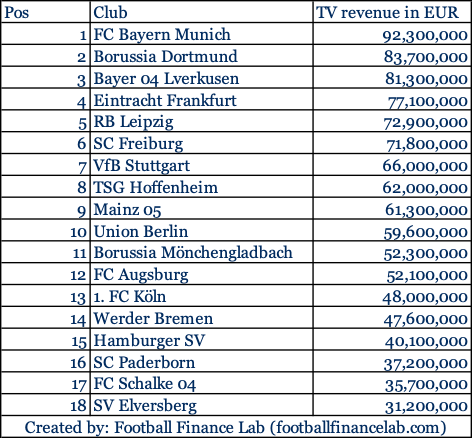
Bayern Munich, as always, is at the top of the Bundesliga with 92.3 million euros. This puts the German record champions well ahead of Borussia Dortmund, who are in second place with 83.7 million euros. Although Bayern will receive almost three times the revenue of SV Elversberg, which is in last place with 31.2 million euros, FC Bayern will still receive significantly less than the last team in the 2024/25 Premier League season, in which Southampton received 126 million euros (a detailed analysis can be found here). Bayer Leverkusen with 81.3 million euros and Eintracht Frankfurt with 77.1 million euros follow in the other places. These two clubs are driven by their good sporting performances in recent years, in which Leverkusen became German champions and Eintracht Frankfurt Europa League winners. This means that they are ahead of RB Leipzig, who will receive 72.9 million euros in fifth place. SC Freiburg follows immediately with 71.8 million euros. In the 60 million euro area, there are VfB Stuttgart (66 million euros), TSG Hoffenheim (62 million euros) and Mainz 05 (61.3 million euros). The median is €60.45 million, while the average is €59.55 million. This shows a very equal distribution between average and median.
Borussia Mönchengladbach is particularly exciting among the lower half of clubs in terms of TV revenue, as they are only in eleventh place with 52.3 million euros. This is due to missing out on international business and weak rankings over the last five years. As a result, Union Berlin is even ahead of Gladbach, which will receive 59.6 million euros. Close to Borussia Mönchengladbach are FC Augsburg with 52.1 million euros, 1. FC Köln with 48 million euros and Werder Bremen with 47.6 million euros. The last four are far behind and are also peppered with traditional clubs. Hamburger SV will receive 40.1 million euros, SC Paderborn 37.2 million euros, Schalke 04 35.7 million euros and SV Elversberg in last place 31.2 million euros. It is surprising that SC Paderborn finishes ahead of Schalke 04, since Schalke spent the last three years in the second division, but before that they played mainly in the Bundesliga.