
This article contains affiliate links. If you purchase through these links, Football Finance Lab may earn a commission at no additional cost to you.
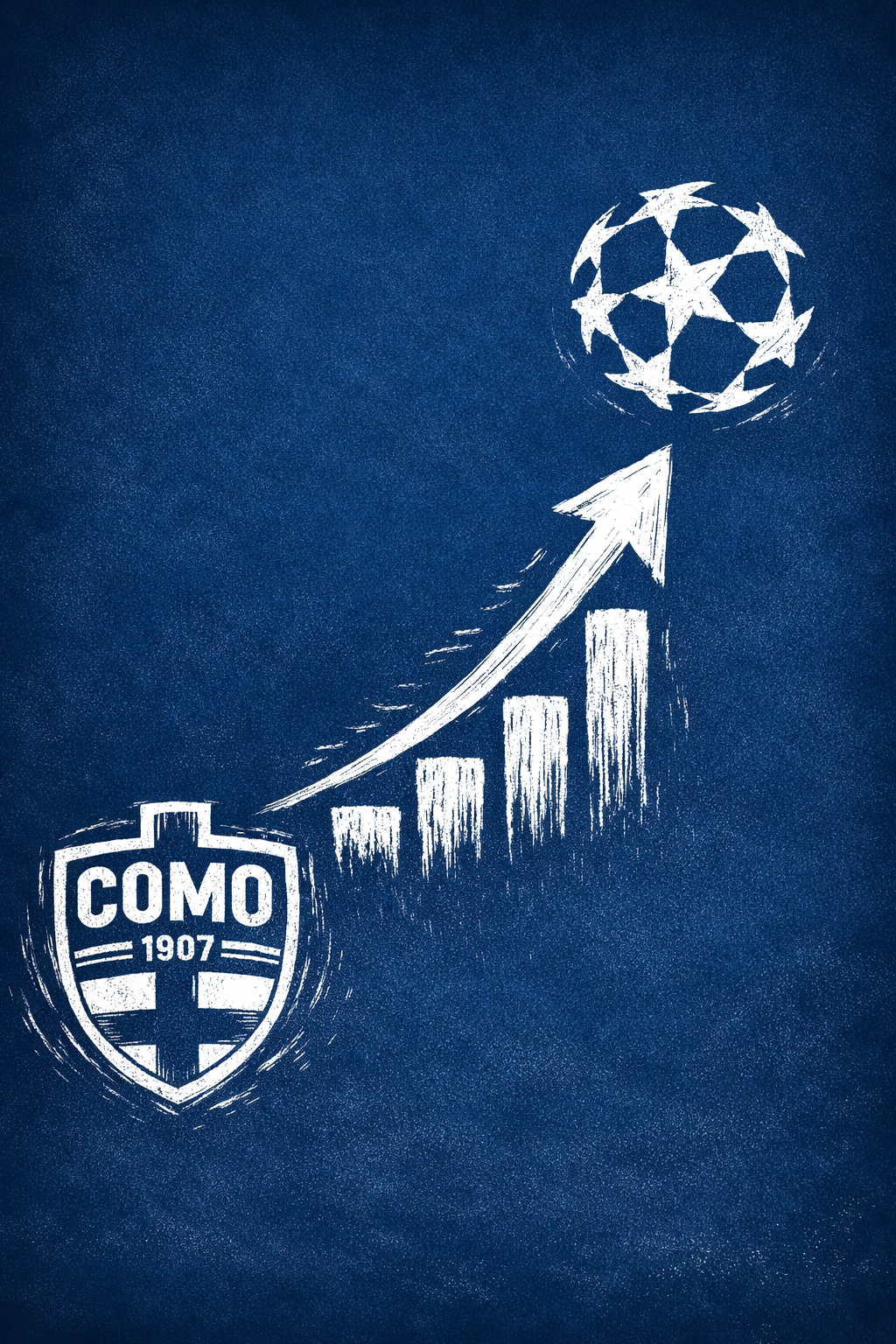
Como qualified for the Champions League next season with a fourth-place finish in Serie A. The club will thus compete in the premier class for the first time in its history. In this article, we analyze how this rapid rise came about and who the faces of Como’s success are behind the scenes.
The Billionaire Takeover That Transformed Como
With 29th place in the all-time Serie A table, Como is not one of the largest and most traditional clubs in Italy. Nevertheless, the club had already had several years in Serie A in the 70s and 80s. In the 1980s, the club even made it to the Italian top flight for five consecutive years. After a fall to Serie C, the club quickly made it back to Serie A, where Como only played for one year and then fell to Serie D. After several years of financial difficulties and promotion to Serie B, the club had to file for insolvency again in 2017 and was re-founded in Serie D. In April 2019, Como was fully acquired by SENT Entertainment Group. SENT Entertainment is financed by Indonesian brothers Robert Budi Hartono and Michael Bambang Hartono. They have a billion-dollar fortune, which they generate in the tobacco industry with their company Djarum Group. After the Hartonos’ entry, Como returned to Serie B relatively quickly and was able to establish himself well there.
Within five years, the club manages to return from Serie D to Serie A. To achieve this, the club relies on well-known faces from football, which at the same time should also offer added sporting value. The club initially used Cesc Fabregas as assistant coach, then as head coach. Cesc Fabregas also joined as an investor and shareholder, along with Thierry Henry. Even on the pitch, after promotion to Serie A, Como relied on well-known established players such as Pepe Reina, Raphael Varane and Alberto Moreno. However, the club also combines this strategy with young talents, such as Nico Paz, Alex Valle or Assane Diao. For the Hartono brothers, the entry is purely a financial investment and fits into their entire business structure. They took over the club for a reported 350,000€ and thus for an absolute bargain. Mola TV is another Hartonos-owned company that plays another important role in their business. Mola TV held many rights to football broadcasts in Indonesia at the time of its entry and has also been the main sponsor of Como’s jersey since its entry. Mola TV also developed its own TV channel, Como TV, which is now Mola TV’s only business in the sports sector. In this article, we explained how the Premier League in Singapore is building its own streaming platform with Premier League +. SENT also plays another role, as they have a subsidiary, Pure SENT, which specializes in branding and maximizing advertising revenue. Interestingly, in addition to Como, she manages the Saudi Pro League and three Saudi football clubs.
This is where the Hartonos particularly come in. They combine Indonesia’s Netflix with Mola TV and SENT Entertainment, as well as a media production company. They produce documentaries, like Netflix for Wrexham or Sunderland. The Como brand aims to become known worldwide and also takes advantage of the idyllic backdrop around Lake Como. The club also organizes luxury holidays combined with a visit to the stadium. The Hartonos are doing this to drive up the club’s value as quickly as possible. Because they are investing in the club purely for financial reasons and want to open the door to further investors in the club in the future. In doing so, they want to give the super-rich an opportunity to invest in football easily and quickly and then sell their shares in the club to them for a significant profit.
If you want to securely stream international football content like Como TV or Serie A broadcasts, NordVPN is one of the best tools available. It protects your connection, bypasses geo‑blocks and ensures stable HD streaming worldwide.
Como’s Rapid Climb From Serie D to the Champions League
Now let’s look back at the square. Como managed to qualify for the Champions League in the 2026/27 season with a fourth-place finish last season, in only its second season since being promoted back. As a newly promoted team, Como also achieved a strong tenth place in the 2024/25 season. In the first season after promotion, Como strengthened its squad with various new players and spent a total of 160 million euros. Last season it was only 126 million euros, but it was still one of the clubs in Italy that spent the most. With these reinforcements and the continued presence of Cesc Fabregas, a young, up-and-coming coach, Como spent approximately €14 million on replacements in the promotion season, also to secure promotion. This was also exceptional for a Serie B club. Promotion to Serie A and the Champions League isn’t a big surprise due to the high expenditure and isn’t a modern football miracle. While the club remains small, its sporting successes and participation in Europe’s premier league are continually increasing its reputation. In the 2024/25 season, Como only achieved sales of 61 million euros and expenses of 192 million euros, resulting in a loss of 131 million euros. This would be almost impossible for a normal football club to handle. But with Como’s financially strong owners, these losses are simply offset in operations. In the long run, if investors have financial problems, this can lead to the club also experiencing financial difficulties, which we have already analyzed in another article at Leicester City. However, participation in the Champions League and the good placings in Serie A also increase the club’s revenue. With the development of young players and their sale, Como is also trying to create further value for the club, which in the long term should lead to making the club profitable in its operational business as well.
Another factor in the low total turnover is the small, outdated stadium with a capacity of only 14,000 seats. Como currently plans to rebuild the stadium for approximately 70 million euros and, in addition to modernizing it, also increase the stadium’s capacity to 20,000 seats. This could enable the club to generate further revenue in the future. The renovation is scheduled to begin in October 2027 and be completed in 2028. In doing so, Como addresses a problem that is well known in Italian football, which we will highlight in the following article. It will be interesting to see whether Como, with its sporting successes and increased revenue in its operational business, manages to become a well-managing club or whether the Hartonos continue to invest a lot of money in the club. However, if they do not continue to invest, the club will face financial disaster.